How to calculate BMI and healthy weight: Formulas, calculator steps, and standards
Learn the BMI formula (kg/m²), step-by-step calculator instructions, how to calculate ideal body weight (BMI 22), the differences between JASSO and WHO classification standards, and common calculation pitfalls.
Published
BMI formula and calculator steps
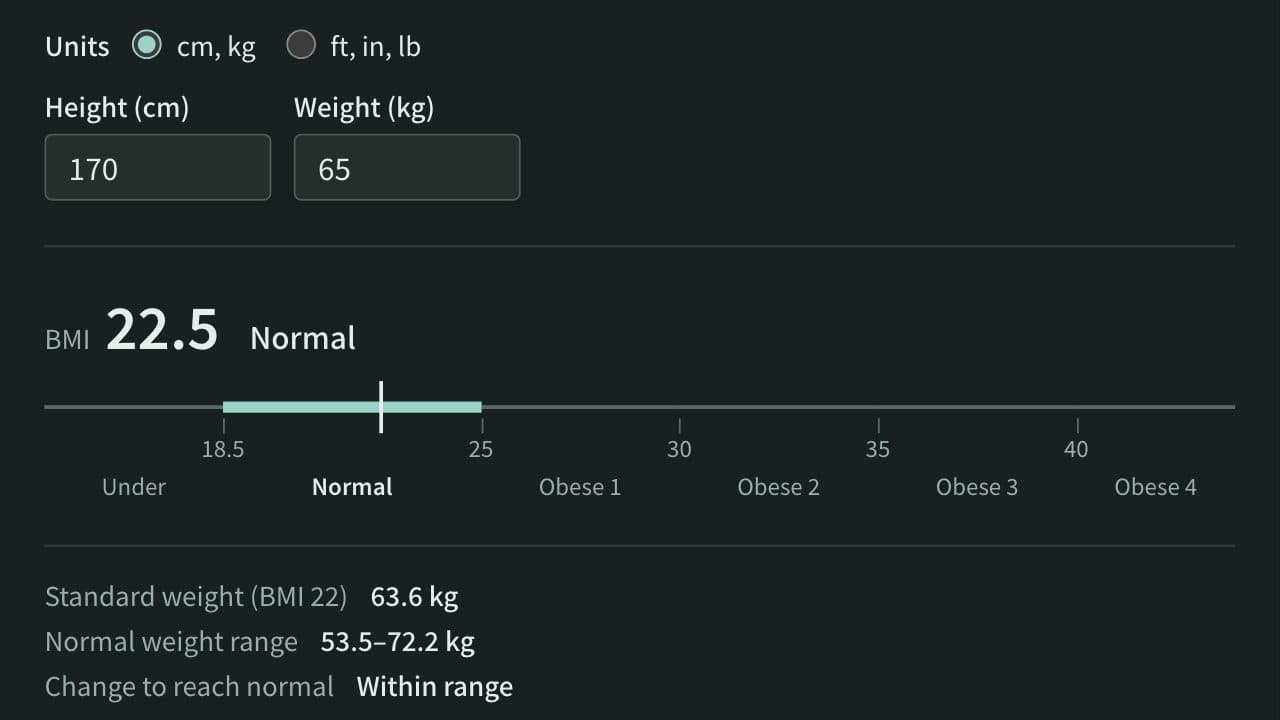
Body Mass Index (BMI) is calculated by dividing weight in kilograms by the square of height in meters. When calculating manually with a standard pocket calculator, the simplest method is to enter weight ÷ height (m) ÷ height (m) in sequence. For example, for an individual who is 170 cm tall and weighs 65 kg, convert height to 1.7 m and press 65 ÷ 1.7 ÷ 1.7, which yields approximately 22.5.
The standard metric formula is:
BMI = weight (kg) ÷ height (m) ÷ height (m)
Why divide by height twice?
In basic arithmetic, A ÷ (B × B) is identical to A ÷ B ÷ B. If you attempt to calculate B × B (height squared) first on a basic calculator, you must write down that intermediate result or use memory keys (M+/MR) before dividing weight by it. Dividing consecutively by height eliminates intermediate notes and memory operations, giving you the final BMI in a single fluid calculation.
Convert centimeters to meters
The most frequent calculation error is entering height directly in centimeters:
- Incorrect:
65 ÷ 170 ÷ 170= approximately0.00225 - Correct:
65 ÷ 1.7 ÷ 1.7= approximately22.49(rounded to22.5)
To convert centimeters to meters, divide by 100 (move the decimal point two places to the left):
- 150 cm → 1.5 m
- 158 cm → 1.58 m
- 165 cm → 1.65 m
- 172 cm → 1.72 m
- 180 cm → 1.8 m
Imperial formula (pounds and inches)
When using pounds (lb) and inches (in), multiply weight by 703 before dividing by height squared:
BMI = 703 × weight (lb) ÷ height (in) ÷ height (in)
The factor 703 approximates the exact unit conversion factor 0.45359237 ÷ 0.0254² ≈ 703.0695....
Calculating standard weight and the normal weight range
Once you know your BMI, you can also determine your ideal standard weight and normal weight range based on height.
Ideal body weight formula (BMI 22)
The Japan Society for the Study of Obesity (JASSO) and several medical guidelines define BMI 22 as the statistically ideal weight associated with the lowest prevalence of lifestyle-related illnesses. The formula is:
Standard weight (kg) = 22 × height (m) × height (m)
On a calculator, multiply height in meters by itself, then multiply by 22 (e.g., for 170 cm: 1.7 × 1.7 × 22 = 63.58 → 63.6 kg).
Typical standard weights (BMI 22) for common heights:
| Height (cm) | Height (m) | Standard weight (kg) | | :---------- | :--------- | :------------------- | | 150 cm | 1.50 m | 49.5 kg | | 155 cm | 1.55 m | 52.9 kg | | 160 cm | 1.60 m | 56.3 kg | | 165 cm | 1.65 m | 59.9 kg | | 170 cm | 1.70 m | 63.6 kg | | 175 cm | 1.75 m | 67.4 kg | | 180 cm | 1.80 m | 71.3 kg | | 185 cm | 1.85 m | 75.3 kg |
Normal weight range (BMI 18.5 to 24.9)
BMI 22 is simply a benchmark. Clinically, any value between BMI 18.5 and 24.9 is classified as normal weight:
- Lower bound:
18.5 × height (m) × height (m) - Upper bound:
25.0 × height (m) × height (m)(any value below 25.0)
For a height of 170 cm, 18.5 × 1.7² ≈ 53.5 kg and 25.0 × 1.7² = 72.25 kg, resulting in a normal weight range of approximately 53.5 kg to 72.2 kg. This represents a healthy window of roughly 18.7 kg.
Differences between JASSO and WHO standards
Depending on whether you use Japanese medical checkups or international health apps, your classification might differ. Both use the identical formula, but they categorize BMI values above 25 differently.
| BMI Range | JASSO Classification (Japan) | WHO Classification (International) | | :------------- | :--------------------------- | :--------------------------------- | | Less than 18.5 | Underweight | Underweight | | 18.5 to 24.9 | Normal weight | Normal weight | | 25.0 to 29.9 | Obesity (Class 1) | Pre-obesity / Overweight | | 30.0 to 34.9 | Obesity (Class 2) | Obesity class I | | 35.0 to 39.9 | Obesity (Class 3) | Obesity class II | | 40.0 and above | Obesity (Class 4) | Obesity class III |
Why Japan classifies BMI 25+ as obesity
Under WHO criteria, a BMI of 25 to 29.9 is categorized as "overweight" or "pre-obese," reserving "obesity" for 30 and above.
JASSO defines 25 and above as obesity because East Asian populations, including Japanese individuals, have a genetic tendency to accumulate visceral fat rather than subcutaneous fat at lower overall body weights. Epidemiological studies demonstrate that risk of metabolic disorders—such as type 2 diabetes, hypertension, and dyslipidemia—rises significantly in East Asian individuals starting at BMI 25. Consequently, Japanese preventive medicine establishes a lower threshold for obesity.
Obesity vs. Obesity disease
Medical guidelines differentiate between physical classification and clinical pathology:
- Obesity: A physical body mass classification indicating a BMI of 25 or greater.
- Obesity disease (Adiposity-based chronic disease): A diagnosed condition where obesity is accompanied by health impairments (hypertension, diabetes, sleep apnea, joint disorders) or visceral fat accumulation that warrants clinical weight reduction therapy.
A BMI above 25 does not automatically mean a clinical diagnosis, but serves as a prompt for evaluating lifestyle habits.
Spreadsheet formulas (Excel and Google Sheets)
To calculate BMI across multiple rows in Excel or Google Sheets, use the following formulas where column A contains height in centimeters and column B contains weight in kilograms:
BMI formula
=ROUND(B2 / ((A2 / 100) ^ 2), 1)
Standard weight formula (BMI 22)
=ROUND(22 * ((A2 / 100) ^ 2), 1)
Category formula (JASSO standard)
Using the IFS function:
=IFS(
  B2 / ((A2/100)^2) < 18.5, "Underweight",
  B2 / ((A2/100)^2) < 25, "Normal weight",
  B2 / ((A2/100)^2) < 30, "Obesity (Class 1)",
  B2 / ((A2/100)^2) < 35, "Obesity (Class 2)",
  B2 / ((A2/100)^2) < 40, "Obesity (Class 3)",
  TRUE, "Obesity (Class 4)"
)
Important considerations and limitations
BMI is an accessible screening metric, but because it relies strictly on total weight and height, it does not distinguish between muscle, bone, and fat.
1. High muscle mass may lead to false obesity classifications
Athletes and individuals who perform strength training often have dense muscle mass and very low body fat. Their BMI may register above 25, placing them in "Obesity Class 1." In such cases, body fat percentage, waist circumference, and blood test results should be reviewed alongside BMI.
2. Older adults require different target BMI ranges
The Dietary Reference Intakes for Japanese (Ministry of Health, Labour and Welfare) set higher target BMI ranges for older adults to prevent frailty, undernutrition, and sarcopenia:
- Ages 18–49: 18.5 to 24.9
- Ages 50–64: 20.0 to 24.9
- Ages 65 and older: 21.5 to 24.9
For older adults, staying near the lower threshold of 18.5 can elevate the risk of immune dysfunction and falls. Maintaining a slightly fuller build (BMI above 21.5) is recommended.
3. Pediatric criteria differ from adults
Because body proportions vary dramatically during childhood and adolescence, adult BMI cutoffs do not apply to children. Pediatric health tracking relies on the Rohrer index or age- and sex-specific BMI percentile growth charts (such as CDC growth curves).
Automatic calculation with the BMI Calculator
When you need immediate results without manual calculations or wish to see how much weight you need to gain or lose to reach the normal range, use the App Museum BMI Calculator.
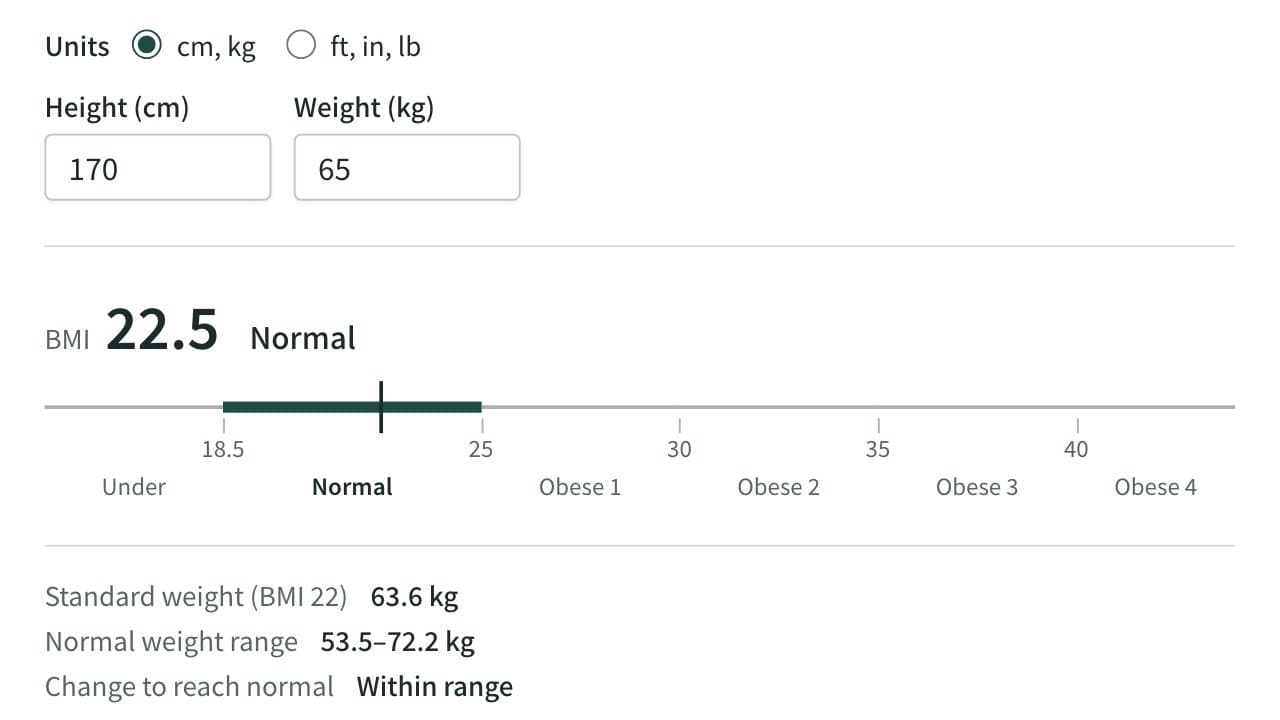
- Instant results with visual scale: Entering your height and weight immediately calculates your BMI, category, standard weight, and normal weight range, complete with a visual marker showing your position relative to classification boundaries.
- Delta to normal weight: If your result falls outside the normal range, the calculator displays the exact difference in weight (e.g.,
-3.5 kgor+2.1 lb) required to reach normal weight. - Supports imperial and metric units: You can toggle between centimeters/kilograms and feet, inches, and pounds. Conversions use exact international standards (1 inch = 2.54 cm, 1 pound = 0.45359237 kg) rather than approximations.
- Privacy-first architecture: All calculations run locally in your browser. No personal health metrics or inputs are transmitted to any server.
References
- Japan Society for the Study of Obesity (JASSO): Guidelines for the Management of Obesity Disease
- Ministry of Health, Labour and Welfare: Dietary Reference Intakes for Japanese
- World Health Organization (WHO): A healthy lifestyle - WHO recommendations
- Centers for Disease Control and Prevention (CDC): About Adult BMI
Apps for this guide
BMI Calculator
Calculate BMI, the corresponding weight category, standard weight, and the normal weight range with the change needed to reach it from height and weight. Enter centimeters and kilograms, or feet, inches, and pounds.