Age & Date Difference Calculator
Calculate exact age, East Asian age, total days, total weeks, the days until the next birthday, and the Japanese school grade from a start date and a reference date.
How to use
- Enter the date to count from in "Start date (e.g. date of birth)"
- Enter the date to count up to in "Reference date". It starts as today's date, and the "Today" button resets it to today at any time
- Once both dates are set, the exact duration (years, months, days), total days, total weeks, the weekday of the start date, the next anniversary, the East Asian age, and the Japanese school grade appear automatically
Besides finding a current age from a date of birth, you can use it to measure the interval between any two dates.
What you can use it for
- Find a current age: enter the date of birth as the start date and leave the reference date as today
- Find an age on a particular day: change the reference date to the day you care about, such as an enrollment or application date. It can be in the past or the future
- Count years of service or anniversaries: enter a hiring date or anniversary as the start date to see how many years and months have passed
- Count days since birth: the total days and total weeks fields show how many days and weeks old a baby is
- Count the days until an event: enter today's date as the start date and the event date as the reference date; the remaining days appear in total days
- Find the weekday you were born on: it is shown in "Start weekday"
- Count the days until the next birthday or anniversary: "Next anniversary" shows its date and weekday, how many days are left, and how many years it will mark
- Find the East Asian age (kazoedoshi): the age used in Japan for occasions such as longevity celebrations and yakudoshi appears in "East Asian age (kazoedoshi)"
- Find a child's school grade in Japan: set the reference date to an entrance ceremony or to April 1 of next school year, and "Japanese school grade" shows the grade at that point, including the three kindergarten classes. For a list of entry and graduation years from elementary school to university, use the School Entrance and Graduation Year Calculator
Examples
This is the result for a start date of 2000-04-01 and a reference date of 2026-07-23.
Exact duration  26 years, 3 months, 22 days
Total days      9,609
Total weeks     1,372
Start weekday   Sat
Next anniversary  2027-04-01 (Thu)
                  in 252 days, marking 27 years
East Asian age (kazoedoshi)  27
Japanese school grade        After a 4-year university
More examples:
1990-08-15to2026-10-11→ 36 years, 1 month, 26 days; total days 13,206; total weeks 1,886; the start date is a Wednesday; the next birthday is2027-08-15(Sun), in 308 days2020-03-10to2026-03-09→ 5 years, 11 months, 27 days (the day before the birthday, so still 5). The next birthday is2026-03-10(Tue), in 1 day, marking 6 years2020-03-10to2026-03-10→ 6 years, 0 months, 0 days (the year count goes up on the birthday itself). The next birthday is a year ahead,2027-03-10(Wed), in 365 days2026-10-11to2027-01-01→ 0 years, 2 months, 21 days; total days 82; the next anniversary is2027-10-11(Mon), in 283 days, marking 1 year2020-04-02to2026-10-18→ 6 years, 6 months, 16 days; East Asian age 7; Japanese school grade: kindergarten, 5-year-old class (nencho)1989-01-15to2001-10-01→ 12 years, 8 months, 16 days; East Asian age 13; Japanese school grade: junior high school, year 1 (hayaumare)
How it is calculated
Years, months, and days are counted in this order.
- Count how many whole months have passed from the start date to the reference date. If the day of the month of the reference date has not reached that of the start date, the current month is not counted yet
- Divide the months by 12 to split them into years and remaining months
- The days from the last whole-month mark to the reference date become the "days" part
When a month has no day matching the start date's day of the month, the end of that month is treated as the whole-month mark.
2026-01-31to2026-02-28→ 0 years, 1 month, 0 days (February has no 31st, so February 28 is exactly one month)2026-01-31to2026-03-01→ 0 years, 1 month, 1 day2024-02-29to2025-02-28→ 1 year, 0 months, 0 days (for a leap-day birthday, a full year is counted on February 28 in a common year)
Total days is the difference between the two dates. The start date is not counted; the day after it is day 1, and counting runs through the reference date. Two identical dates give 0, and 2026-01-01 to 2026-12-31 gives 364. Add 1 to the result if you want to count both the first and the last day. Total weeks is total days divided by 7, rounded down.
East Asian age (kazoedoshi) counts the year of birth as 1 and adds one every January 1 (New Year's Day). It is the reference date's year minus the start date's year, plus 1. It does not follow the lunar New Year or the start of spring.
"Japanese school grade" treats the start date as a date of birth and gives the grade, in the Japanese school year (April 1 to March 31) that the reference date falls in, of someone who entered in April with no gap years, repeated years, or skipped grades. It counts 6 years of elementary school, 3 of junior high school, 3 of high school, and 4 of university. The three years before elementary school are shown with the kindergarten and nursery class names nensho (3-year-old class), nenchu (4-year-old class), and nencho (5-year-old class), and anything earlier as not yet in those classes.
The school-year cutoff is one day off from the exact duration. Children enter elementary school on the first April 1 after the day they turn 6, and under Japanese law age goes up at the end of the day before the birthday, so someone born on April 1 turns 6 on March 31 and enters school the next day, April 1. That is why people born from April 2 to April 1 of the next year share a school year, and people born from January 1 to April 1 (hayaumare) are one school year ahead of those born from April 2 of the same year. The exact duration goes up on the birthday itself.
- Born
2000-04-01→ elementary school, grade 1 on April 1, 2006 - Born
2000-04-02→ still in the nencho class on April 1, 2006, and elementary school, grade 1 on April 1, 2007
"Next anniversary" is the first date after the reference date that has the same month and day as the start date. It is counted from the reference date, not from today, so changing the reference date gives the next birthday as seen from that point. "in N days" counts the day after the reference date as day 1, and "marking N years" is how many whole years will have passed on that date. If the reference date is the birthday itself, the birthday one year ahead is shown. For a start date of February 29, it falls on February 28 in a common year and on February 29 in a leap year.
Things to note
- Only dates are used; the time of birth is not taken into account
- If the reference date is before the start date, "Reference date must be on or after the start date" is shown and there is no result
- No result is shown for dates before the year 100
- "Japanese school grade" is shown only for dates of birth that enter elementary school in or after April 1947, when Japan's current school system under the School Education Act began (born on or after April 2, 1940)
- With gap or repeated years, skipped grades, schools outside Japan, September entry, colleges of technology, junior colleges, vocational schools, 6-year programs such as medicine, and other different lengths, "Japanese school grade" will not match the actual grade
- Procedures that have their own rule for counting age may differ from this calculator by one day. For cases such as leap-day birthdays, check the guidance of the organization concerned
FAQ
Are leap years taken into account?
Yes. February 29 is included in total days. 2024-02-29 to 2028-02-29 gives 4 years, 0 months, 0 days and 1,461 total days.
How is age counted for a February 29 birthday?
In a year that is not a leap year, a full year is counted on February 28. With 2024-02-29 as the start date, 2025-02-28 gives 1 year, 0 months, 0 days and 2025-03-01 gives 1 year, 0 months, 1 day. "Next anniversary" follows the same rule: a reference date of 2025-02-27 shows 2025-02-28 (Fri), and a reference date of 2027-03-01 shows 2028-02-29 (Tue).
Are the days until the next birthday counted from today?
They are counted from the reference date. The reference date starts as today, so unless you change it, the count is from today. With 2000-04-01 as the start date and 2026-07-23 as the reference date, the next birthday is 2027-04-01 (Thu), in 252 days.
What happens if the reference date is before the start date?
An error message is shown. To count back into the past, put the older date in the start date and the newer one in the reference date.
Does it support East Asian age reckoning?
Yes. "East Asian age (kazoedoshi)" shows the age that counts the year of birth as 1 and adds one every New Year's Day. For someone born on 2000-04-01, it is 27 on 2026-07-23 (26 in exact age).
Which school year is someone born on April 1 in?
The same as people born from April 2 of the previous year (hayaumare). Under Japanese law, age goes up at the end of the day before the birthday, so someone born on April 1 turns 6 on March 31 and enters elementary school the next day, April 1. Someone born on 2000-04-01 becomes an elementary school first grader in April 2006, and someone born on 2000-04-02 in April 2007.
Can it list entry and graduation years?
This calculator shows only the grade on the reference date. To list the entry and graduation years from elementary school to university in both the Gregorian and Japanese era calendars, use the School Entrance and Graduation Year Calculator.
Does total days count both the start date and the reference date?
No. The start date is not counted; the day after it is day 1, and counting runs through the reference date. If you want to count both the start date and the reference date, add 1 to the total days shown.
Can I enter dates in the Japanese era calendar?
There is no field for Japanese era names. Enter the year, month, and day in the Gregorian calendar.
Is the date of birth I enter saved?
No. The calculation runs entirely in your browser, and the dates you enter are neither sent to a server nor stored. Reloading the page clears the start date and resets the reference date to today.
- Type
- Utility
- Category
- Calculators
- Tags
- age
- date
- difference
- school
- calculator
Related apps
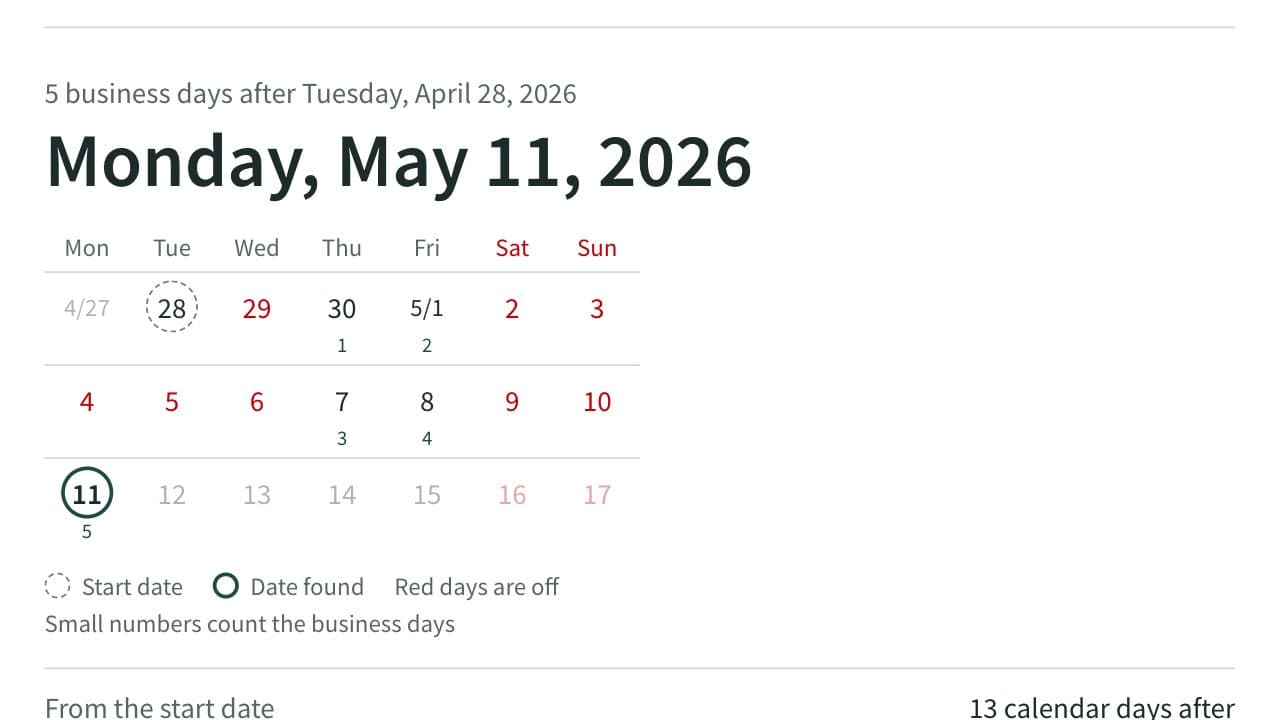
Business Day Calculator with Japanese Holidays
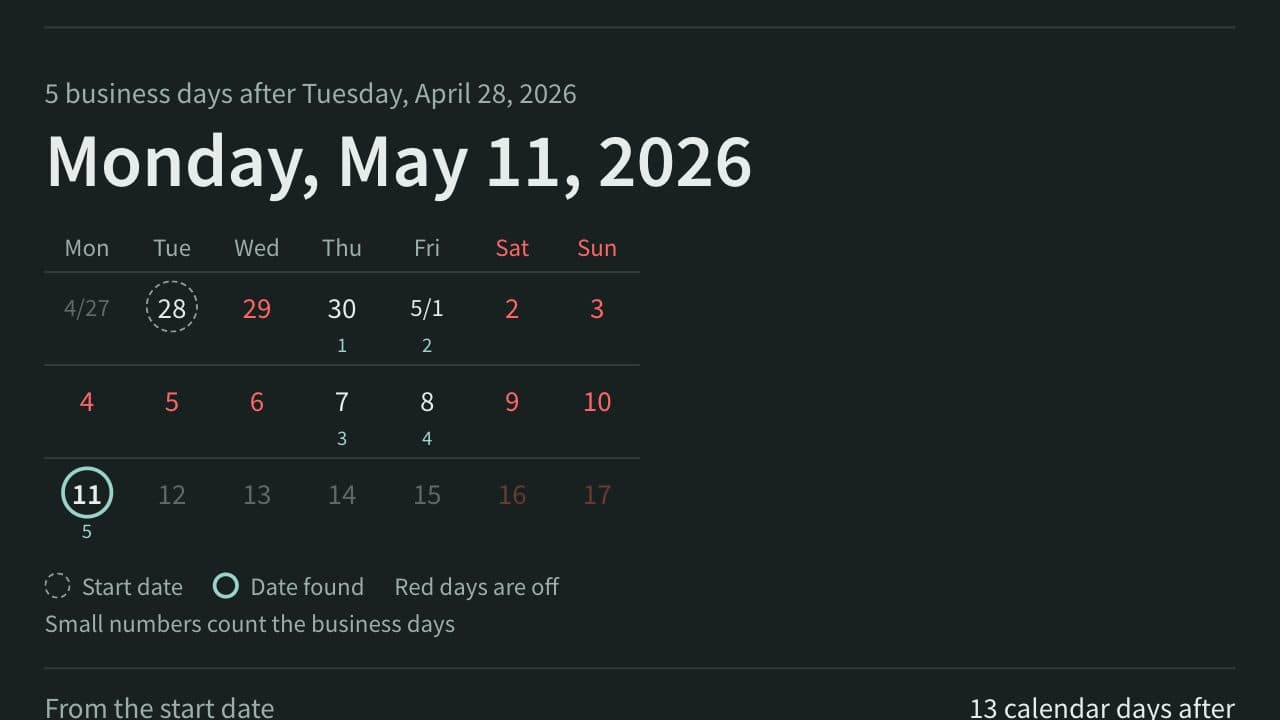
Find the date a number of business days after or before a start date, or count the business days between two dates, skipping weekends and Japanese national holidays. List each month's business days with its first, Nth, and last business day. Add New Year closures, extra days off, and your own weekly days off.
Due Date and Pregnancy Week Calculator (Japan)
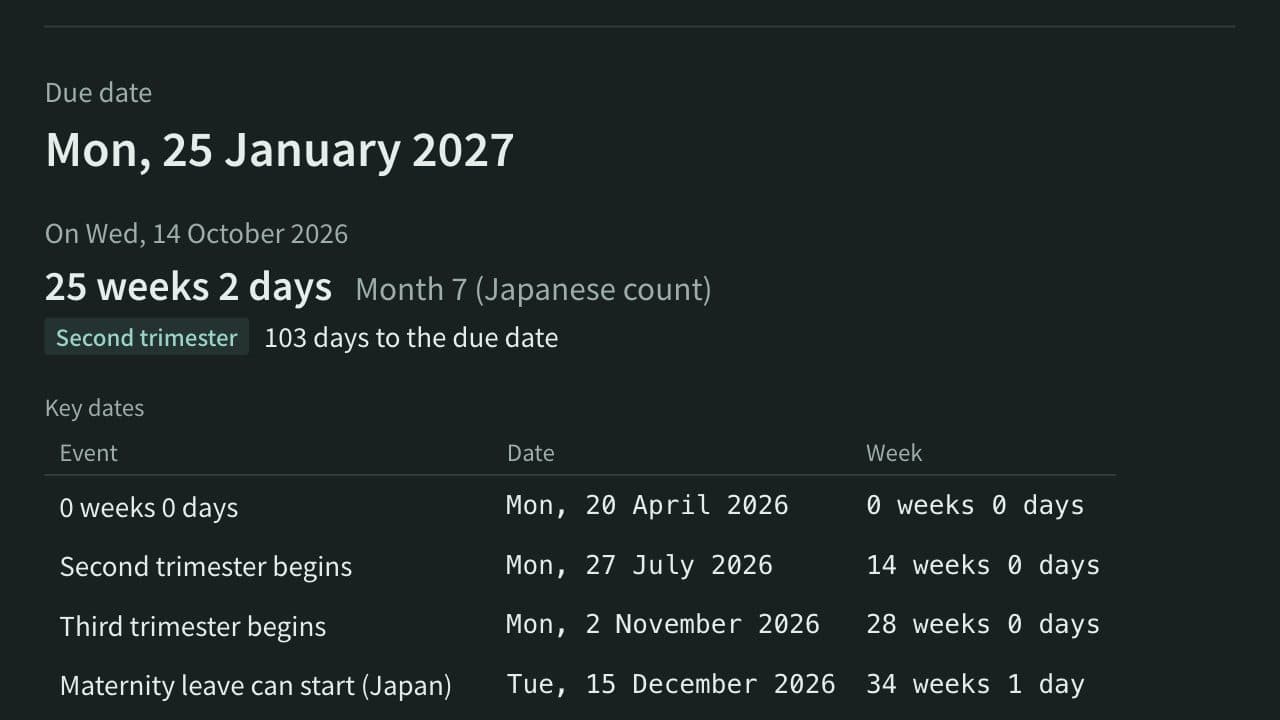
Work out the due date, today's week of pregnancy, the Japanese pregnancy month and the trimester from the last period, a known due date, ovulation or an embryo transfer, with cycle length, term dates, Japanese maternity leave dates and the standard schedule of prenatal checkups.
Date Calculator: Add or Subtract Days
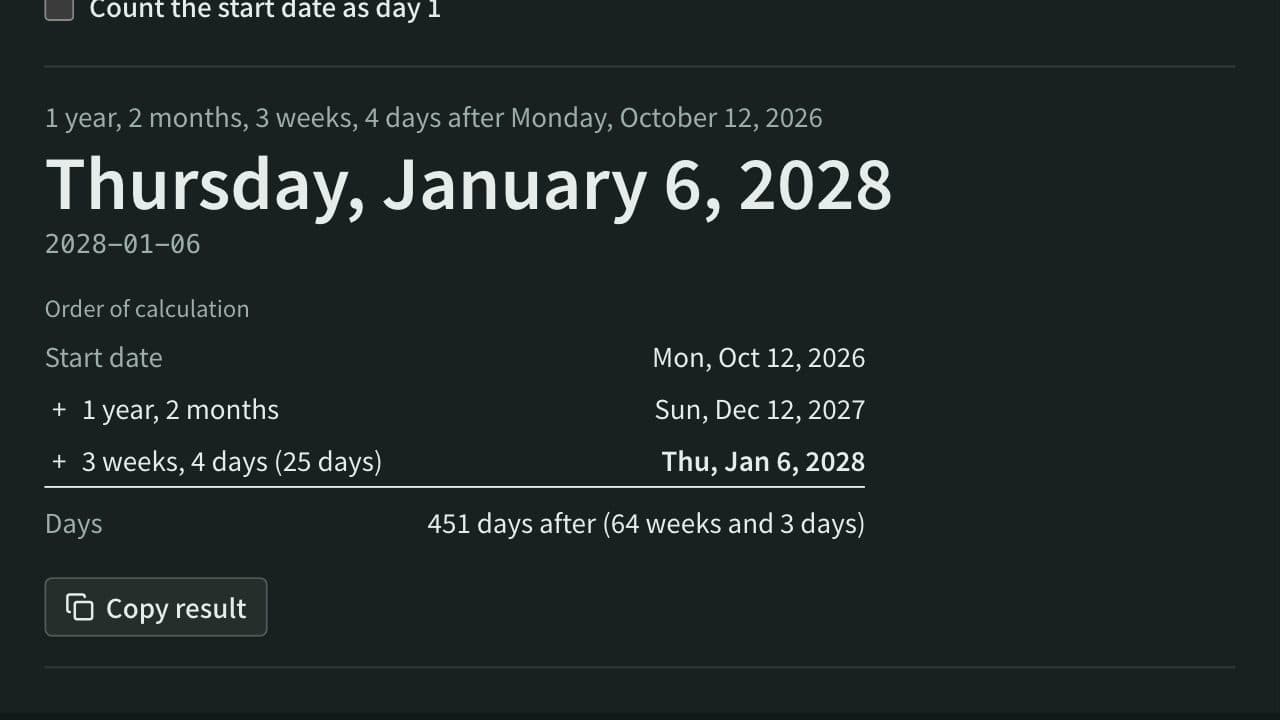
Find the date and weekday a number of days before or after a start date. Add or subtract years, months, weeks, and days together, count the start date as day 1, and see how many days apart the two dates are.