Due Date and Pregnancy Week Calculator (Japan)
Work out the due date, today's week of pregnancy, the Japanese pregnancy month and the trimester from the last period, a known due date, ovulation or an embryo transfer, with cycle length, term dates, Japanese maternity leave dates and the standard schedule of prenatal checkups.
Blank means 28
Enter a date to see the due date and the week of pregnancy.
How to use
- Under "Date you know", choose what kind of date you have. "Last period" is selected first
- Enter the date. For "Last period", enter the day your last period started (day 1)
- With "Last period", you can enter your usual "Cycle length (days)". A blank field counts as 28 days
- With "Embryo transfer", choose how many days the embryo had grown (day 2, 3, 5 or 6) under "Embryo transferred"
- "Week on this date" starts as today. Change it to see the week on another day, and press "Today" to return
Once a date is entered, the result shows the due date, the week of pregnancy on the chosen day (weeks and days), the Japanese pregnancy month, the trimester and the days left to the due date. "Key dates" below lists when the second and third trimesters begin, the term window (37 to 41 weeks), the first day maternity leave can start in Japan and more. Open "Prenatal checkups (Japan's standard 14)" to see the weeks and dates of the standard checkups, and "Dates of each week" to see the dates of every week from 0 to 41.
The result is an estimate. If a clinic has given you a due date, choose "Due date" and enter it to count the weeks the same way the clinic does.
Example
The last period started on 1 January 2026 and the cycle is 28 days.
- Due date: Thursday, 8 October 2026
- On 20 May 2026: 19 weeks 6 days, month 5, second trimester, 141 days to the due date
- Second trimester begins (14 weeks 0 days): 9 April 2026
- Third trimester begins (28 weeks 0 days): 16 July 2026
- Maternity leave can start: 28 August 2026 (3 July 2026 for twins or more)
- Term: from 17 September 2026 (37 weeks 0 days) to 21 October 2026 (41 weeks 6 days)
- Postnatal leave ends if born on the due date: 3 December 2026
- Prenatal checkups: visit 1 (week 8) is 26 February to 4 March 2026 and visit 14 (week 39) is 1 to 7 October 2026. After 20 May, the next is visit 4 (week 20, 21 to 27 May)
Changing the inputs gives the following.
- Cycle length
35: the due date becomes 15 October 2026, and 20 May is 18 weeks 6 days - "Due date" with 8 October 2026: the same result as a last period on 1 January 2026
- "Ovulation or conception" with 15 January 2026: the due date is 8 October 2026
- "Embryo transfer" on 15 June 2026 with a "Day 5 (blastocyst)" embryo: the due date is 3 March 2027. With "Day 3 (cleavage)" it is 5 March 2027
How it is calculated
Weeks of pregnancy are counted from the first day of the last period, which is "0 weeks 0 days". Each 7 days adds a week, and 40 weeks 0 days (280 days later) is the due date.
Each kind of input sets 0 weeks 0 days as follows.
- Last period: that day is 0 weeks 0 days. If the cycle is not 28 days, the count moves by the difference (see "Cycle length adjustment" below)
- Due date: 280 days before it is 0 weeks 0 days
- Ovulation or conception: that day is 2 weeks 0 days. The due date is 266 days (38 weeks) later
- Embryo transfer: the transfer date minus the embryo's age is the day of fertilisation, which is 2 weeks 0 days. The due date is 261 days after the transfer for a day-5 blastocyst and 263 days after for a day-3 embryo
The pregnancy month follows the Japanese count of 4 weeks to a month: weeks 0–3 are month 1, weeks 4–7 are month 2, and weeks 36–39 are month 10. No month is shown from 40 weeks on.
Naegele's rule
A common way to work out a due date by hand is Naegele's rule: take 3 from the month of the last period and add 7 to the day. For a period that started in January to March, add 9 to the month instead; for April to December, the result falls in the next year. If adding 7 goes past the end of the month, carry over into the next month. For 1 January 2026 this gives 8 October 2026, and for 1 October 2026 it gives 8 July 2027.
Because the rule ignores how long each month is, it lands 0–3 days later than the day 280 days on, depending on the month and on leap years. For 1 March 2026, Naegele's rule gives 8 December, while 280 days later is 6 December. This tool counts the 280 days.
Cycle length adjustment
Counting from the last period assumes a 28-day cycle with ovulation around day 14. A longer cycle suggests later ovulation and a shorter one earlier ovulation, so the tool moves 0 weeks 0 days and the due date later (or earlier) by the difference from 28 days.
- 35-day cycle: 7 days later
- 21-day cycle: 7 days earlier
With an irregular cycle, or if it is unclear when ovulation happened, a count from the last period drifts more. Clinics often adjust the week and the due date after measuring the baby on an early ultrasound scan. Enter an adjusted due date with "Due date".
Trimesters and term
The stages follow the terms defined by the Japan Society of Obstetrics and Gynecology.
- First trimester: 0 weeks 0 days to 13 weeks 6 days
- Second trimester: 14 weeks 0 days to 27 weeks 6 days
- Third trimester: 28 weeks 0 days onwards
- Term (seikisan in Japanese): 37 weeks 0 days to 41 weeks 6 days. A birth in this window is on time. In English usage, "full term" sometimes means only 39 weeks 0 days to 40 weeks 6 days, within this window
- From 42 weeks 0 days the result says "Past the due date (post-term)"
Some Japanese magazines and local government leaflets instead treat the end of month 4 (15 weeks 6 days) as the end of the first trimester and start the second at 16 weeks. Weeks 14 and 15 are named differently depending on which split is used.
Maternity leave dates in Japan
Under Japan's Labor Standards Act, a working woman may take leave before birth from 6 weeks before the due date (14 weeks for twins or more) if she asks for it. The day of birth counts as part of this leave, so the first day it can start is 42 days (98 days for twins or more) back from the due date, counting the due date itself.
Leave after birth lasts 8 weeks (56 days) from the day after the birth. "Key dates" shows when it ends if the baby is born on the due date.
- Born earlier than the due date: leave before birth is shorter, and leave after birth runs for 8 weeks from the day after the actual birth
- Born later than the due date: the days from the due date to the birth also count as leave before birth
- After 6 weeks, a woman who asks may return to work a doctor approves without waiting the full 8 weeks
Check the actual leave and any maternity allowance or childcare leave with your employer and health insurer.
Prenatal checkups in Japan
"Prenatal checkups (Japan's standard 14)" applies the visit intervals that Japan's Ministry of Health, Labour and Welfare gives as its standard example of prenatal checkups to the date you entered.
- Until 23 weeks 6 days: every 4 weeks
- 24 weeks 0 days to 35 weeks 6 days: every 2 weeks
- 36 weeks 0 days until the birth: every week
With the first checkup at 8 weeks, that makes 14 visits: weeks 8, 12, 16 and 20; weeks 24, 26, 28, 30, 32 and 34; and weeks 36, 37, 38 and 39. The dates in the table are the 7 days of that week. After the 14th at 39 weeks, weekly checkups go on until the birth.
If "Week on this date" falls in the week of a checkup, that row shows "This week"; otherwise the row of the next checkup shows "Next". Neither appears for a date after the week of the 14th or before 0 weeks 0 days.
This is a standard example. The actual dates, the number of visits and the tests depend on the clinic and on the doctor's view of the health of the mother and baby. For twins or more, ask your clinic how often to come. In Japan, public funds help pay for the checkups once a pregnancy is reported to the city, town or village where you live; ask your municipality how many checkups are covered and what they include.
Accepted values
- Dates from 1 January 1900 to 31 December 2099
- Cycle length is a whole number of days from 20 to 45. A blank field counts as 28
- Weeks are shown for days from 0 weeks 0 days to 43 weeks 6 days. Choosing a day before or after that range says so instead
- "Number of babies" is used only for the first day of maternity leave. It does not change the prenatal checkups
FAQ
Why count from the last period?
The day of ovulation or fertilisation is usually not known for certain, so the count starts from the first day of the last period, which is easy to remember. Fertilisation falls at roughly 2 weeks 0 days.
My clinic gave a different week.
The week and due date are often adjusted after an early ultrasound scan. Enter the due date the clinic gave you with "Due date" to get the same week.
What about IVF or a frozen embryo transfer?
Choose "Embryo transfer" and enter the transfer date and the embryo's age. Blastocysts are usually day 5 or 6, and cleavage-stage embryos day 2 or 3. If the clinic has given you a due date, enter that with "Due date" instead.
What about IUI or timed intercourse?
If you know the day of ovulation, choose "Ovulation or conception" and enter it.
When does each pregnancy month start?
Each month is 4 weeks. Month 2 starts at 4 weeks 0 days, month 5 at 16 weeks 0 days, month 8 at 28 weeks 0 days and month 10 at 36 weeks 0 days. "Dates of each week" lists the month of every week.
Are many babies born on the due date?
Few babies arrive exactly on the due date. A birth anywhere from 37 weeks 0 days to 41 weeks 6 days, the term window (37 to 41 weeks), is on time.
Must leave before birth start 6 weeks before?
No. Leave before birth is taken only if the worker asks, and it can start later than 6 weeks before. Leave after birth is required: as a rule, she may not work for 8 weeks, except after 6 weeks with a doctor's approval.
Is the date I enter saved?
No. The calculation runs entirely in your browser, and the dates are never sent to a server or stored. Reloading the page clears them.
- Type
- Utility
- Category
- Calculators
- Tags
- pregnancy
- due-date
- date
- calendar
- maternity-leave
- prenatal-checkup
- health
- calculator
Related apps
Business Day Calculator with Japanese Holidays
Find the date a number of business days after or before a start date, or count the business days between two dates, skipping weekends and Japanese national holidays. List each month's business days with its first, Nth, and last business day. Add New Year closures, extra days off, and your own weekly days off.
BMR Calculator
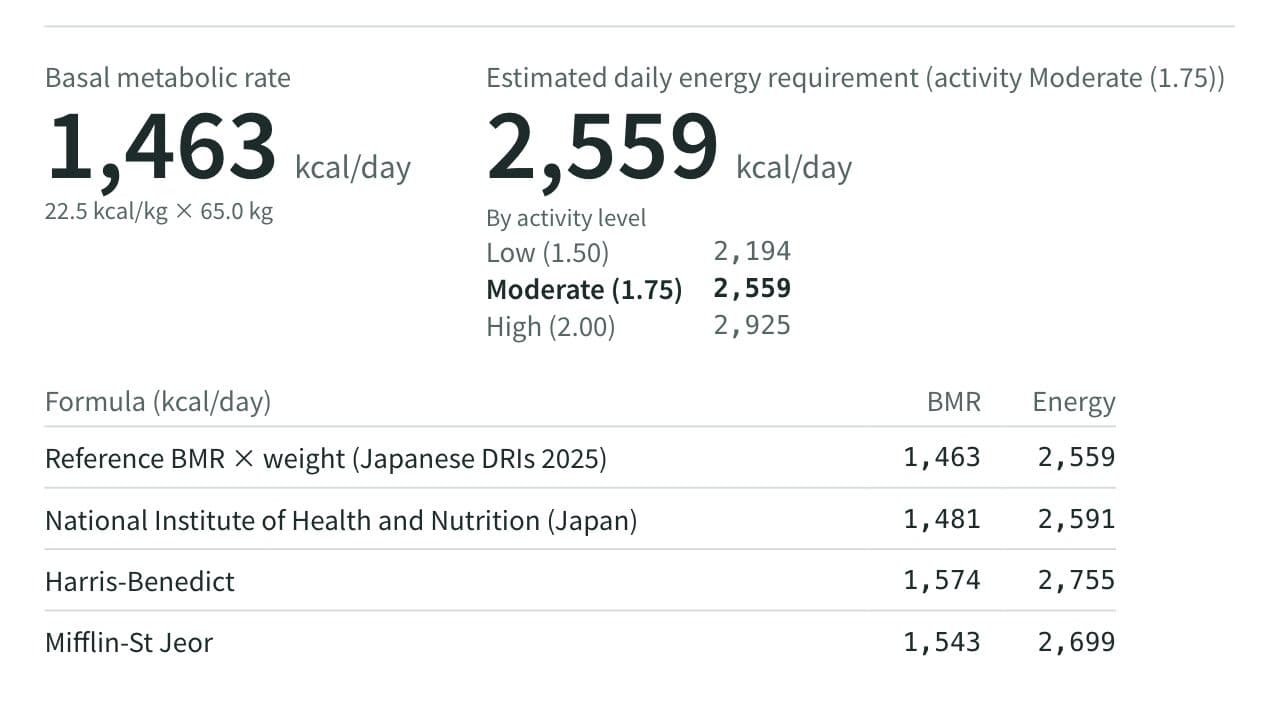
Calculate your basal metabolic rate from sex, age, height, and weight, with the estimated daily energy requirement at low, moderate, and high activity levels and at a target weight. Compare the Japanese DRIs 2025 reference values, the National Institute of Health and Nutrition (Japan) equation, Harris-Benedict, Mifflin-St Jeor, and Katch-McArdle from body fat.
BMI Calculator
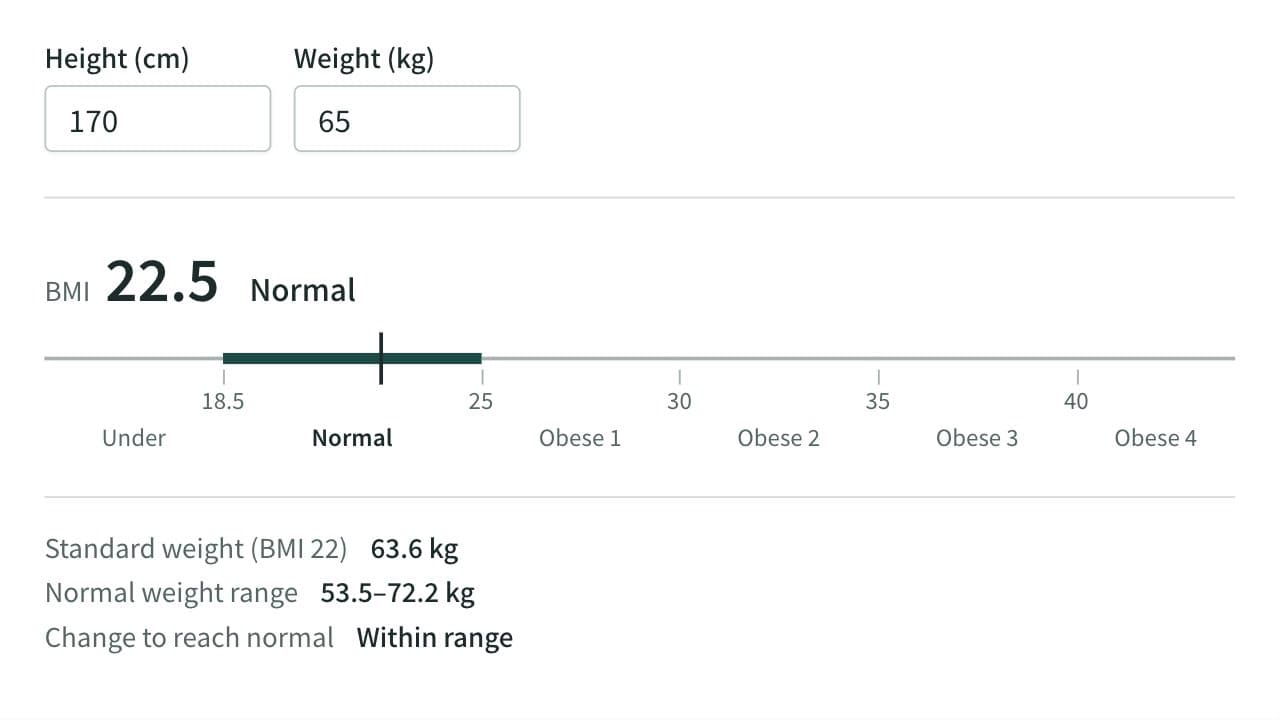
Calculate BMI, the corresponding weight category, standard weight, and the normal weight range with the change needed to reach it from height and weight.