BMR Calculator
Calculate your basal metabolic rate from sex, age, height, and weight, with the estimated daily energy requirement at low, moderate, and high activity levels and at a target weight. Compare the Japanese DRIs 2025 reference values, the National Institute of Health and Nutrition (Japan) equation, Harris-Benedict, Mifflin-St Jeor, and Katch-McArdle from body fat.
Adds the Katch-McArdle formula, which works from lean body mass.
Adds a guide to staying at that weight.
Enter age, height, and weight to see the basal metabolic rate here
How to use
- Choose male or female under “Sex” (male is selected at first).
- Enter your age, height, and weight. Height and weight accept one decimal place, and full-width digits such as
170.5are read too. - Under “Physical activity level”, choose the one closest to your daily life: low, moderate, or high (moderate is selected at first).
- The result shows your basal metabolic rate (kcal/day) and the estimated daily energy requirement at the chosen activity level. Under “By activity level” it lists the requirement for low, moderate, and high, with the chosen level in bold. The table below compares the values from other formulas.
There is no calculate button. The result appears once age, height, and weight are all filled in. Entering a body fat percentage adds the Katch-McArdle formula to the table. Entering a target weight shows the basal metabolic rate and estimated energy requirement at that weight (a guide to staying there) and how it differs from your current weight. “Copy results” copies the inputs and every formula's figures as text.
The calculator is for ages 18 and over. Accepted ranges are age 18–120, height 100–250 cm, weight and target weight 20–300 kg, and body fat 2–70%.
What basal metabolic rate means
Basal metabolic rate (BMR) is the energy your body uses at rest while awake, just to keep going: breathing, keeping warm, and so on. It makes up much of the energy you use in a day. It tends to be higher for larger bodies and lower with age.
The energy you actually use in a day (calories burned) is BMR plus the energy used to digest and absorb food (diet-induced thermogenesis) and the energy of moving around. As in the Dietary Reference Intakes for Japanese (2025) from Japan's Ministry of Health, Labour and Welfare, this calculator multiplies BMR by a physical activity level and shows the result as the “estimated energy requirement”.
Estimated energy requirement (kcal/day) = BMR (kcal/day) × physical activity level
Formulas
The large BMR figure is the reference BMR per kilogram from the Dietary Reference Intakes for Japanese (2025) multiplied by your weight. The table lists the following formulas. W is weight (kg), H is height (cm), and A is age (years).
- Reference BMR × weight (Japanese DRIs 2025): the “BMR per kg of body weight” for your sex and age band, times your weight
- National Institute of Health and Nutrition (Japan) equation (Ganpule et al., 2007): built from measurements of Japanese adults
- Harris-Benedict (the original 1919 equation): long used around the world
- Mifflin-St Jeor (1990): widely used by calculators outside Japan
- Katch-McArdle: uses only lean body mass (weight minus fat), worked out from body fat. Shown only when body fat is entered
National Institute of Health and Nutrition (Japan)
  Men   (0.0481W + 0.0234H − 0.0138A − 0.4235) × 1000 ÷ 4.186
  Women (0.0481W + 0.0234H − 0.0138A − 0.9708) × 1000 ÷ 4.186

Harris-Benedict
  Men   66.4730 + 13.7516W + 5.0033H − 6.7550A
  Women 655.0955 + 9.5634W + 1.8496H − 4.6756A

Mifflin-St Jeor
  Men   10W + 6.25H − 5A + 5
  Women 10W + 6.25H − 5A − 161

Katch-McArdle
  370 + 21.6 × W × (1 − body fat ÷ 100)
In the National Institute of Health and Nutrition equation, the bracket gives the daily energy in MJ (megajoules); multiplying by 1000 ÷ 4.186 turns it into kcal.
The reference BMR values (kcal/kg/day) are:
- 18–29: men 23.7, women 22.1
- 30–49: men 22.5, women 21.9
- 50–64: men 21.8, women 20.7
- 65–74: men 21.6, women 20.7
- 75 and over: men 21.5, women 20.7
Below the result, a “Reference” line shows the BMR at the reference weight (the median weight for that age band), exactly as printed in the Dietary Reference Intakes table.
Intermediate steps are kept exact and only the final figures are rounded to the nearest 1 kcal. The energy requirement is also worked out from the unrounded BMR, so it can differ by 1 kcal from the shown BMR times the activity level.
Physical activity level
The physical activity level is how many times BMR your total daily energy use is. The energy used to digest food is included in this multiple. This calculator uses the values from the Dietary Reference Intakes for Japanese (2025), which change with the age band:
- 18–64: low 1.50, moderate 1.75, high 2.00
- 65–74: low 1.50, moderate 1.70, high 1.90
- 75 and over: low 1.40, moderate 1.70 (no high level is given)
If you choose “High” at 75 or over, the energy requirement shows “—” and the reason is explained.
The levels roughly mean:
- Low: mostly seated, with quiet activities for most of the day
- Moderate: mainly seated work, plus one of: moving around or standing at work, walking to commute or shop, housework, or light sport
- High: work with a lot of moving or standing, or a habit of vigorous exercise such as sport in leisure time
Example
A 35-year-old man, 170 cm and 65 kg, with a moderate activity level (1.75):
Reference BMR × weight     22.5 × 65 = 1,462.5 → 1,463 kcal/day (energy 2,559)
NIHN (Japan) equation      1,481 kcal/day (energy 2,591)
Harris-Benedict            1,574 kcal/day (energy 2,755)
Mifflin-St Jeor            1,543 kcal/day (energy 2,699)
With 20% body fat, lean body mass is 65 × 0.8 = 52 kg, and Katch-McArdle gives 370 + 21.6 × 52 = 1,493 kcal/day (energy 2,613).
Even for the same person, the formulas differ by around 100 kcal.
The estimated energy requirement at each activity level (reference BMR × weight):
Low (1.50)        1,462.5 × 1.50 = 2,193.75 → 2,194 kcal/day
Moderate (1.75)   1,462.5 × 1.75 = 2,559.375 → 2,559 kcal/day
High (2.00)       1,462.5 × 2.00 = 2,925 kcal/day
With a target weight of 60 kg, the basal metabolic rate is 22.5 × 60 = 1,350 kcal/day and the estimated energy requirement is 1,350 × 1.75 = 2,362.5 → 2,363 kcal/day, which is 196 kcal/day less than at the current weight.
Notes
- The figures are estimates built from group averages. People of the same age and build still differ in actual BMR, for example with muscle mass.
- The reference BMR values are set for people near the reference weight. They tend to overestimate BMR for people with obesity and underestimate it for lean people.
- Harris-Benedict was built from data on people of European descent and has been reported to give higher values than measured for Japanese adults. In a comparison among healthy Japanese adults, the National Institute of Health and Nutrition equation had the smallest error (Miyake et al., 2011).
- Pregnancy and breastfeeding have separate additional amounts in the Dietary Reference Intakes and are not included here.
- If you are being treated for an illness or want to plan weight loss or gain, consult a doctor or registered dietitian.
- Your inputs are calculated only in your browser and are never sent or saved.
FAQ
Which formula should I use?
For Japanese adults, the large “reference BMR × weight” figure or the National Institute of Health and Nutrition equation is a sensible starting point. If your weight is far from the reference weight, the National Institute of Health and Nutrition equation, which also uses height and age, tends to fit better. If you have an accurate body fat measurement, Katch-McArdle is useful too. You can also treat the spread across formulas as a rough range.
Is the estimated energy requirement how many calories I should eat?
It is a guide to the energy needed to keep your weight where it is. The Dietary Reference Intakes themselves treat it as a reference figure and advise adjusting how much you eat by watching how your weight changes.
Is the target weight result how much to eat while losing weight?
No. It is a guide to keeping that weight once you are there. The calculator does not work out how much to eat on the way to the target, or how fast your weight would change. As weight changes, so do the basal metabolic rate and the energy used in moving, so real weight change does not follow a simple subtraction. The target figure uses the same reference BMR × weight method as the headline result. To plan weight loss or gain, talk to a doctor or registered dietitian.
Can I calculate for someone under 18?
Children also use energy to grow, and their activity levels differ by age, so this calculator is limited to ages 18 and over.
How do I measure body fat?
A home body composition scale (a scale with a body fat reading) can measure it. The reading changes with how much water is in your body, so measuring at the same time each day makes readings easier to compare. Measurement error is large, so read the Katch-McArdle figure as approximate.
I know my weight in pounds and height in feet
This calculator takes cm and kg. Convert them first with the Unit Converter. To see your BMI and healthy weight range as well, use the BMI Calculator.
- Type
- Utility
- Category
- Calculators
- Tags
- bmr
- calorie
- health
- weight
- calculator
Related apps
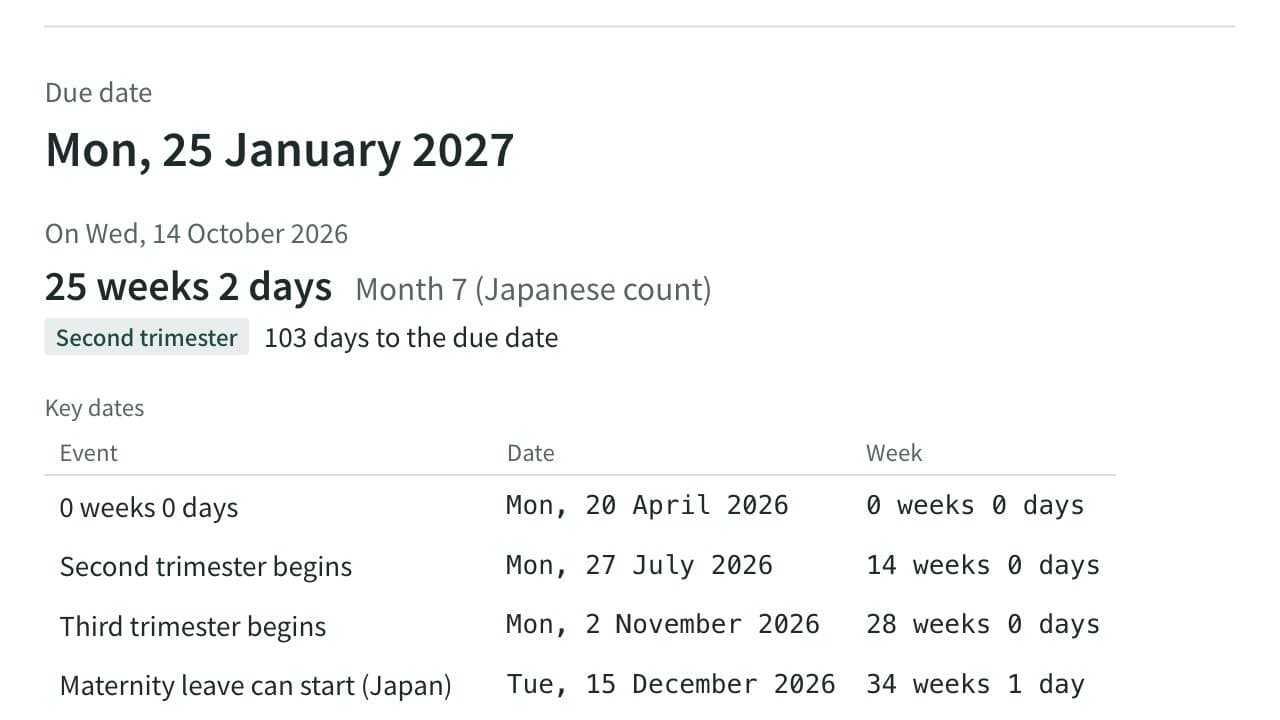
Due Date and Pregnancy Week Calculator (Japan)
Work out the due date, today's week of pregnancy, the Japanese pregnancy month and the trimester from the last period, a known due date, ovulation or an embryo transfer, with cycle length, term dates, Japanese maternity leave dates and the standard schedule of prenatal checkups.
Elapsed Time Calculator
Calculate elapsed, remaining, and active time from start, end, current time, and breaks, or work out the end time from the active time. Also adds and subtracts durations such as 1:30 or 2h 15m and converts them to decimal hours.
Split Bill Calculator
Work out what each person pays from the total and the head count. Round payments to 10, 100, 500, or 1,000, let some groups pay a larger share or a set amount, and see how much is collected and left over. When several people paid, it also works out who pays whom to settle up.