Compound Interest and Savings Calculator
Work out what monthly deposits and a starting amount grow to with compound interest, split into contributions and gain, or find the monthly deposit needed to reach a target, with a year-by-year table. You can also see how long a balance lasts when you take out the same amount every month.
- Final amount
- —
- Total contributed
- —
- Investment gain
- —
How to use
- Under "What to calculate", choose "Final amount", "Monthly deposit" or "Withdrawals". "Final amount" is selected at first. "Withdrawals" is explained under "Drawing down a balance"
- For "Final amount", enter what you put in every month under "Monthly deposit", such as
300. If you chose "Monthly deposit", enter the "Target amount" instead - If you already have money set aside, enter it under "Starting amount (optional)". Leave it blank if you have none
- Enter the yearly rate under "Expected return (% per year)", such as
3or4.5 - Enter a whole number of years under "Period (years)"
Once the required fields are filled in, the final amount, the total contributed and the investment gain appear on the right, with a year-by-year table below. There is no calculate button: the result updates whenever you change a field.
Example
Depositing 30,000 (30000) every month for 20 years at an expected return of 3%:
- Final amount 9,849,059.94
- Total contributed 7,200,000.00 (30,000 × 240 deposits)
- Investment gain 2,649,059.94 (26.9% of the final amount)
Changing one condition at a time gives:
- A return of 5%: final amount 12,331,010.06, investment gain 5,131,010.06
- A period of 30 years: final amount 17,482,106.54, total contributed 10,800,000.00, investment gain 6,682,106.54
- A starting amount of 1,000,000 (
1000000): final amount 11,669,814.94, total contributed 8,200,000.00, investment gain 3,469,814.94
To grow a lump sum of 1,000,000 at 3% for 20 years with no deposits, leave "Monthly deposit" blank and enter 1000000 under "Starting amount". The final amount is 1,820,755.00.
Working back from a target
Choosing "Monthly deposit" under "What to calculate" works out how much you need to deposit every month to reach a target.
For a target of 20,000,000 (20000000) at an expected return of 3% over 30 years:
- Monthly deposit needed 34,320.81
- Total contributed 12,355,490.43
- Investment gain 7,644,509.57
Changing one condition at a time gives:
- A return of 5%: monthly deposit needed 24,030.99
- A period of 20 years: monthly deposit needed 60,919.52
- A starting amount of 3,000,000 (
3000000): monthly deposit needed 21,672.69
If the starting amount grows to the target on its own, the monthly deposit needed is 0.00 and the page says "The starting amount reaches the target on its own, so no monthly deposit is needed." The "Final amount" then shows what the starting amount alone grows to, which can be more than the target.
Drawing down a balance
Choosing "Withdrawals" under "What to calculate" works out how a balance holds up when you take the same amount out of it every month. Whatever has not been taken out yet keeps earning the expected return.
- Enter the balance you start from under "Balance to draw from"
- Enter what you take out every month under "Monthly withdrawal"
- Fill in "Expected return (% per year)" and "Withdrawal period (years)"
For "Final amount" and "Monthly deposit", a "Draw down this amount" button appears under the result (not when the final amount is under 1). It switches to "Withdrawals" with the final amount filled in as the balance to draw from and moves to the "Monthly withdrawal" field. The expected return carries over as it is. The savings period and the withdrawal period are separate fields.
Taking 100,000 (100000) a month out of a balance of 20,000,000 (20000000) at an expected return of 3% over a withdrawal period of 30 years:
- Balance at the end 0.00
- Total withdrawn 27,760,559.98
- Gain while withdrawing 7,760,559.98
Two sentences appear under the result:
- The balance runs out 23 years 2 months after withdrawals start. Withdrawal 278 is the last, and only 60,559.98 is left to take out then.
- To use up the balance in exactly 30 years, withdraw 84,320.81 a month.
At 0% the balance would run out after 20,000,000 ÷ 100,000 = 200 withdrawals (16 years 8 months). Because the rest keeps earning 3%, about 7,760,000 more than the starting balance can be taken out in total.
Changing one condition at a time gives:
- A withdrawal period of 20 years: balance at the end 3,584,900.09, total withdrawn 24,000,000.00. There is still a balance at the end, and the page says it would run out 23 years 2 months after withdrawals start if you kept going. Using it up in exactly 20 years takes 110,919.52 a month
- A monthly withdrawal of 150,000 (
150000): the balance runs out after 13 years 7 months, with withdrawal 163 as the last - A return of 5%: the balance at the end of 30 years is 6,129,022.74, and it runs out 35 years 11 months after withdrawals start
- A monthly withdrawal of 50,000 (
50000): each month's gain (20,000,000 × 3% ÷ 12 = 50,000) covers the withdrawal, so the page says the balance does not go down
If taking the same amount out for 100 years still does not empty the balance, the page says "Taking out the same amount, the balance does not run out within 100 years."
The "Balance by year" table under the result lists, for each year, the total withdrawn so far, the gain while withdrawing so far, and the balance at the end of that year. It ends with the year the balance runs out. In the example above, year 1 shows withdrawn 1,200,000.00, gain 591,680.86 and balance 19,391,680.86, and year 24 shows withdrawn 27,760,559.98, gain 7,760,559.98 and balance 0.00. On a wide screen, a bar beside each row shows the balance at the end of that year, on the scale of the largest balance (the starting balance, unless the balance grows).
Formula
The monthly rate is the yearly rate divided by 12. With r as the monthly rate, P the starting amount, M the monthly deposit and n the number of deposits (years × 12):
final amount = P × (1 + r)^n + M × ((1 + r)^n − 1) ÷ r
With T as the target, the monthly deposit needed is the same formula solved for M. When the starting amount reaches the target on its own (the formula gives 0 or less), the deposit is 0 instead:
monthly deposit = (T − P × (1 + r)^n) × r ÷ ((1 + r)^n − 1)
The calculation assumes the following.
- Interest compounds once a month. What a month earns is added to the balance and earns from the next month
- Deposits are made at the end of each month. The first deposit arrives at the end of month 1 and starts earning the month after
- The starting amount earns from the beginning
- The return stays the same for the whole period
- At an expected return of 0%, the final amount is P + M × n and the monthly deposit needed is (T − P) ÷ n (0 if P is T or more)
For withdrawals, with B as the balance to draw from and W the monthly withdrawal, the balance after k withdrawals and the monthly withdrawal that uses the balance up in exactly n withdrawals (the withdrawal period in years × 12) are:
balance after k withdrawals = B × (1 + r)^k − W × ((1 + r)^k − 1) ÷ r
withdrawal that uses it up = B × r ÷ (1 − (1 + r)^−n)
- Withdrawals are made at the end of each month, after that month's gain has been added
- In the month the balance falls short of the withdrawal, everything left is taken out and that is the last withdrawal. A balance under half of the smallest amount shown (a cent on this page) also counts as run out
- When the monthly withdrawal is B × r or less, the gain covers it and the balance does not go down
- At an expected return of 0%, the balance is B − W × k and the withdrawal that uses it up is B ÷ n
Reading the year-by-year table
Each row is one year. "Contributed" is everything paid in by the end of that year (the starting amount plus the deposits so far), "Gain" is the growth so far, and "Balance" is the amount at the end of that year.
For the example of 30,000 a month at 3% for 20 years:
- Year 1: contributed 360,000.00, gain 4,991.48, balance 364,991.48
- Year 10: contributed 3,600,000.00, gain 592,242.57, balance 4,192,242.57
- Year 20: contributed 7,200,000.00, gain 2,649,059.94, balance 9,849,059.94
The contributions rise by the same amount every year, but the gain rises faster in the later years: about 590,000 in the first ten years and about 2,060,000 in the last ten. That is compounding, where the growth itself earns a return.
On a wide screen, a bar beside each row splits that year's balance into contributions (lighter) and gain (darker). The bars are on the same scale as the final amount.
Rounding, and how real investing differs
The tool does not round during the calculation. It rounds only for display, to two decimal places. Because of that, the displayed contributions and gain can add up to 0.01 more or less than the displayed balance.
The Japanese page shows whole amounts with no decimals, because yen has no smaller unit.
In real investing, the following affect the outcome but are not part of this calculation.
- Tax on the gain. In Japan the usual rate is 20.315%, except in tax-exempt accounts such as NISA
- Costs such as fund management fees and purchase fees
- Inflation, which changes what the money is worth
- Changing returns. The return of funds and shares differs every year, and the balance can fall below what was paid in
- Changes to the deposit along the way, extra deposits and withdrawals while saving (to draw down a balance after saving, use "Withdrawals")
- Pension or other income while withdrawing, and changes to the withdrawal along the way
The amounts shown are estimates that assume a constant return. They do not indicate future investment results.
Accepted values
- The monthly deposit and the starting amount are numbers from 0 to 10 billion. Enter digits only, without thousands separators
- For "Final amount", either the monthly deposit or the starting amount is enough on its own. While both are blank or 0, the result shows "—"
- The target amount is a number from 1 to 10 billion
- The expected return is a number from 0 to 100. A negative return cannot be entered
- The period is a whole number from 1 to 50. Fractions of a year cannot be entered
- A value outside these ranges replaces the result with a message naming the field to fix
- Combinations whose final amount is above 1 trillion are not shown
- The withdrawal period is a whole number from 1 to 50
- Under "Withdrawals", the balance to draw from is a number from 1 to 1 trillion and the monthly withdrawal a number above 0, up to 1 trillion. The limit is higher than on the savings side so that large final amounts can be carried over too, but the combinations in the next rule are still not shown
- Under "Withdrawals", nothing is shown when the balance to draw from, left to grow without withdrawals until it runs out (or to the end of the period if it does not), would go above 1 trillion. The rounding error would then be too large to show exact figures
FAQ
Can I enter the amount in thousands or millions?
No. Enter the full amount in digits: 30000 for thirty thousand, 20000000 for twenty million. The Japanese page restates the amount in Japanese units under the field; the English page does not.
What return should I enter?
The tool does not suggest a return. Returns differ widely between products, and nobody knows their future values. Rather than settling on one figure, try a lower and a higher one to see the range of results. For something that earns almost nothing, such as a deposit account, enter 0 to see just the total you paid in.
How is this different from simple interest?
Simple interest is earned only on the original amount; compound interest is also earned on what has already been gained. This tool uses compound interest. 1,000,000 at 3% for 20 years grows to 1,600,000 with simple interest and to 1,820,755.00 with the monthly compounding used here.
Can I compound yearly instead?
No. The tool only compounds monthly. At the same yearly rate, monthly compounding gives slightly more than yearly compounding: for 1,000,000 at 3% over 20 years, about 1,806,111 yearly against 1,820,755.00 monthly.
Why does another calculator give a slightly different result?
Because its assumptions differ. How often interest compounds (monthly or yearly), whether deposits are made at the start or the end of the month, and where amounts are rounded all change the result. This tool's assumptions are listed in the "Formula" section.
Can I use it for a NISA account?
Yes. Gains in a NISA account are not taxed, so the "Investment gain" shown here is an estimate of what you would keep. For a taxable account, take the tax (usually 20.315% in Japan) off the gain. The tool does not check whether the deposits stay within the NISA yearly or lifetime limits.
Can I change the deposit or the return partway through?
No. The same deposit and the same return apply from start to finish. To model a change, calculate the period before the change first, then enter its final amount as the "Starting amount" and calculate the remaining period.
Can I check how long my retirement savings will last?
Yes, with "Withdrawals". Enter your savings under "Balance to draw from" and the amount you are short each month under "Monthly withdrawal", and the page shows how many years and months it takes for the balance to run out. It shows this whether the balance runs out within the withdrawal period or lasts beyond it. Pension and other income, tax and inflation are not part of the calculation, so enter the monthly shortfall after your other income.
Does it work for currencies other than yen?
Yes, the calculation does not depend on the currency. This English page shows two decimal places; the Japanese page shows whole amounts.
Are the amounts I enter saved?
No. The calculation runs entirely in your browser, and the amounts and returns you enter are neither sent to a server nor stored. Reloading the page clears every field.
- Type
- Utility
- Category
- Calculators
- Tags
- compound-interest
- savings
- investment
- nisa
- interest
- money
- calculator
- retirement
- withdrawal
Related apps
Split Bill Calculator
Work out what each person pays from the total and the head count. Round payments to 10, 100, 500, or 1,000, let some groups pay a larger share or a set amount, and see how much is collected and left over. When several people paid, it also works out who pays whom to settle up.
Electricity Cost Calculator
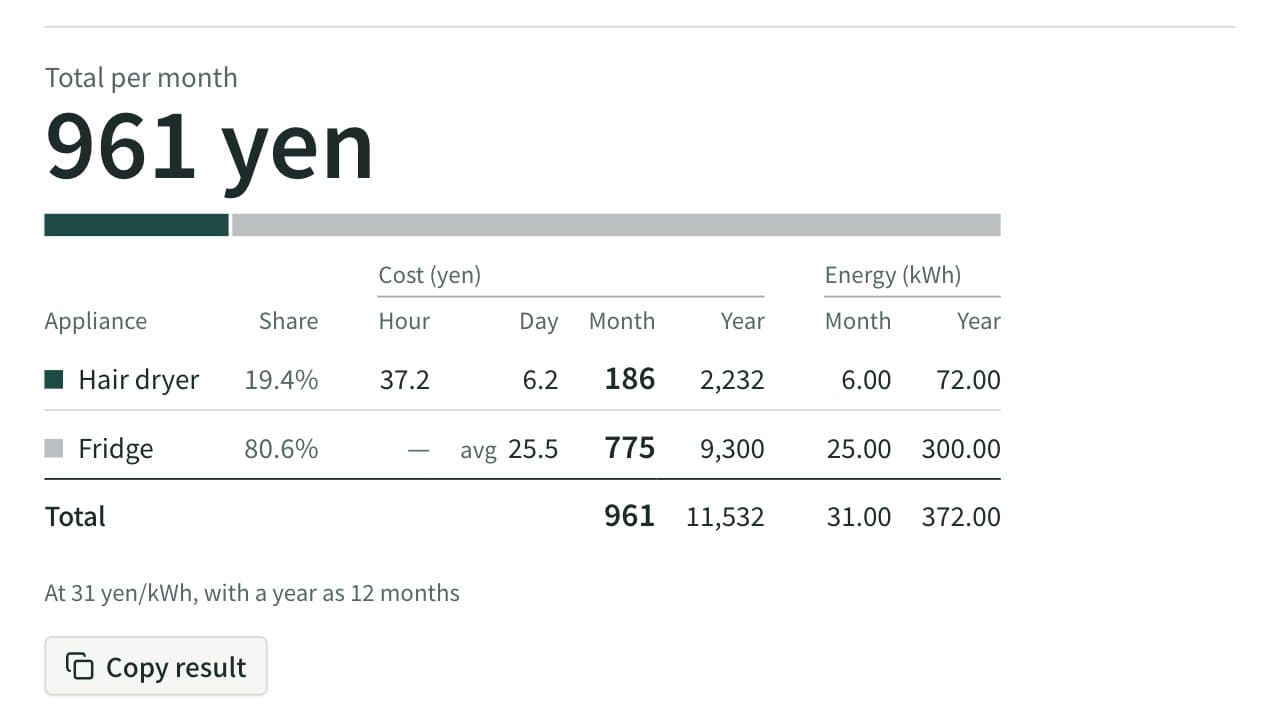
Work out the electricity cost of appliances per hour, day, month, and year from their power in watts and how long they run, or from the yearly kWh on a fridge or air conditioner label. Add several appliances to see the total and each one's share, or compare an appliance with its replacement to see the yearly saving and how long it takes to pay back.
Hourly Pay Calculator
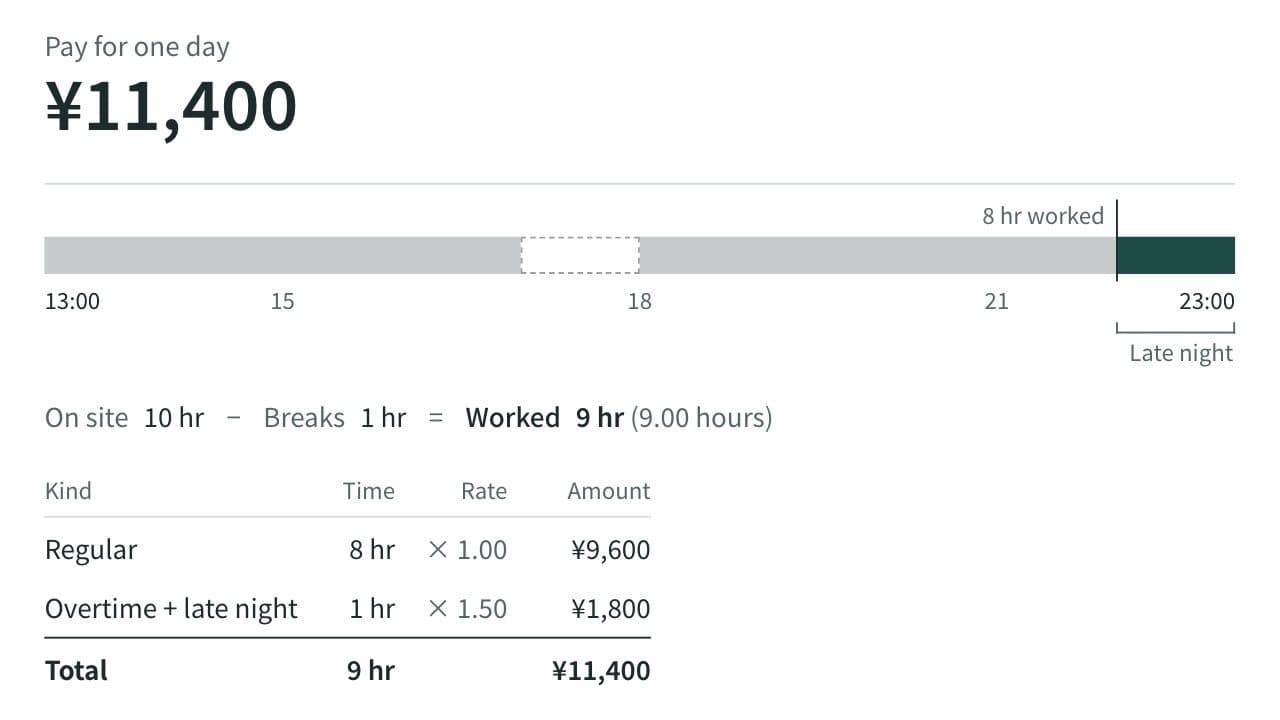
Calculate worked hours and a day's pay from an hourly wage, clock-in, clock-out, and breaks, with overtime past 8 hours, late-night work (22:00–05:00), and work on the statutory day off shown separately at premium rates.