Kana to Romaji Converter (Hepburn)
Convert hiragana and katakana to Hepburn romaji. Choose the passport spelling for names (long vowels left out, M before B, M and P) or Japan's 2025 official spelling, with long vowels marked by a macron or written as the kana spell them.
Kanji cannot be converted, so type the reading in kana. Where two kana are not one long vowel, put ' between them to read them apart (for example こ'うちわ).
Follows the Ministry of Foreign Affairs table: all capitals, long O and U left out, ん written M before B, M and P, and っ written T before CH.
How to use
- Type the word you want in romaji into "Hiragana or katakana". Spaces, such as the one between a family name and a given name, and line breaks are kept in the result
- Under "Spelling", choose the spelling used for passport names or the official spelling Japan revised in 2025
- With the official spelling, you can also choose how long vowels are written (
TōkyōorToukyou) and how capitals are used - The result appears under "Romaji". "Copy" puts it on the clipboard
- Under "Kana by kana", each group of kana is shown above its romaji. Places worth checking are underlined, and the notes below show the same line next to what it means
- Double line (under the kana): read as a long vowel
- Wavy line: a spelling used for a sound outside the table
- Thick line: in the passport spelling, ん or っ written
MorTto match the next sound - Dotted line: left as typed
Kanji cannot be converted, so type the reading in hiragana or katakana. What you type is never sent out of your browser and is not stored.
Example
Typing やまだ たろう gives a different result for each spelling.
- Passport (Hepburn):
YAMADA TARO - Official spelling, with a macron:
Yamada Tarō - Official spelling, as the kana spell them:
Yamada Tarou
Some words where the two spellings differ:
なんば:NAMBAfor a passport,nanbain the official spellingはっちょう:HATCHOfor a passport,hacchōorhacchouin the official spellingおおの ゆうき:ONO YUKIfor a passport,Ōno YūkiorOono Yuukiin the official spellingしんいち:SHINICHIfor a passport,shin'ichiin the official spelling
How the two spellings differ
Both are Hepburn spellings that write shi, chi, tsu, fu and ji. を is written o, ぢ is ji and づ is zu. They differ as follows.
Passport (Hepburn) follows the Hepburn table of Japan's Ministry of Foreign Affairs.
- Everything is in capitals
- ん is written
Monly before B, M and P (ほんま→HOMMA,さんぺい→SAMPEI) - っ doubles the next consonant letter (
はっとり→HATTORI), except beforeCH, where it is writtenT(ほっち→HOTCHI) - Long O and U are not written. The second kana of おう, おお and うう is left out, and so is ー (
こうた→KOTA,おおの→ONO,ゆうこ→YUKO,ニーナ→NINA) - Only an おお at the end of a word is written
OO(せのお→SENOO,よこお→YOKOO). A final おう isO(いとう→ITO) - い is never left out (
にいな→NIINA,けいこ→KEIKO)
Official spelling (2025 revision) follows the Cabinet notice of 22 December 2025, which made Hepburn the basis in place of the earlier Kunrei spelling (si, ti, tu).
- ん is always written
n(しんぶん→shinbun,かんぱい→kanpai) - っ doubles the first letter of the next consonant (
ざっし→zasshi,にっちょく→nicchoku,まっちゃ→maccha) - A long vowel takes a macron over the vowel (
とうほく→tōhoku,かあさん→kāsan) or is written with the vowels the kana spell (touhoku,kaasan) - Even with macrons, いい and えい are written out (
かわいい→kawaii,へいせい→heisei), because the notice describes that as the usual way - An
nfollowed by a vowel oryis separated with'(たんい→tan'i,とんや→ton'ya) - "Capitalize each word" puts a capital at the start of each run of kana. The notice asks for a capital at the start of proper nouns and sentences
Reading two kana apart when they are not a long vowel
This tool decides what is a long vowel from the kana alone. When the same pair of kana happens to fall across a break inside a word, it is read as a long vowel too.
まつうら(matsu + ura) becomesMATSURAfor a passportこうちわ(ko + uchiwa) becomesKOCHIWAfor a passportこうた(ko + uta) becomeskōtawith a macron
In these cases, put an apostrophe ' between the kana, and they are read apart.
まつ'うら→MATSUURAこ'うちわ→KOUCHIWAこ'うた→ko'uta(in the official spelling, the'for the break also appears in the result)
The places read as a long vowel are listed below the result, as in "こう → KO". Check them when you convert a name or a place name.
FAQ
Can it convert kanji directly?
No. A kanji can be read in several ways, and for names and place names even a dictionary cannot settle which one is meant. Kanji are left in the result and listed under "Left as typed". Type the reading in hiragana or katakana. Halfwidth katakana is read as well.
Can I use the result for a passport application as it is?
Treat it as a guide. The name on a passport is checked at the counter against the reading in the family register. Whether a pair of kana is a long vowel (writing まつうら as MATSUURA, for instance) has to be confirmed by someone who knows the reading. A spelling with OH such as OHNO or ITOH, or matching the spelling used by your family, is a request for a non-Hepburn spelling, so ask the office you apply to. Once chosen, the spelling cannot normally be changed.
Are spellings without long vowels, such as Tokyo and judo, wrong?
No. The 2025 notice does not ask for spellings in wide international use (Tokyo, judo, tempura, matcha and so on) to be changed straight away. Written as the notice sets out, they would be Tōkyō or Toukyou, jūdō or juudou, tenpura and maccha. When you need a spelling without long vowels, choose "Passport (Hepburn)". It is in capitals, and ん and っ are written differently too.
は and へ come out as ha and he
Each kana is read on its own, so the particles は and へ also become ha and he. The notice says the particles は, へ and を are written wa, e and o in a sentence. When you convert a sentence, type the particle は as わ and へ as え. を is o in both spellings.
How are ティ, ファ, ヴ and similar sounds converted?
Both tables were made for Japanese words. For a passport, the spellings in the "reference" rows of the Ministry of Foreign Affairs table are used (ティ → TEI, ファ → FUA, ジェ → JIE, ヴァ → BA). V is not allowed. BUA is also accepted for ヴァ, so edit the result if you need it. The official spelling does not cover sounds used only in loanwords. This tool uses the spellings in common use (ti, fa, je, va). ー is treated the same way: with macrons it puts a macron on the vowel before it (ラーメン → rāmen), and otherwise it repeats that vowel (raamen). The spellings chosen this way are listed below the result.
Can it convert to Kunrei spelling (si, ti, tu)?
No. Only the two Hepburn spellings are available. Kunrei was the main spelling under the Cabinet notice of 1954, and the 2025 revision made Hepburn the basis instead.
Sometimes っ or ー is left in the result
っ is shown by doubling the next consonant letter, so it cannot be written when a vowel follows or when it ends a word (あっ, for example). ー cannot be written without a vowel before it either. These characters are left as they are and listed under "Left as typed".
- Type
- Utility
- Category
- Converters
- Tags
- romaji
- hepburn
- hiragana
- katakana
- passport
- japanese
- converter
Related apps
Hiragana and Katakana Converter
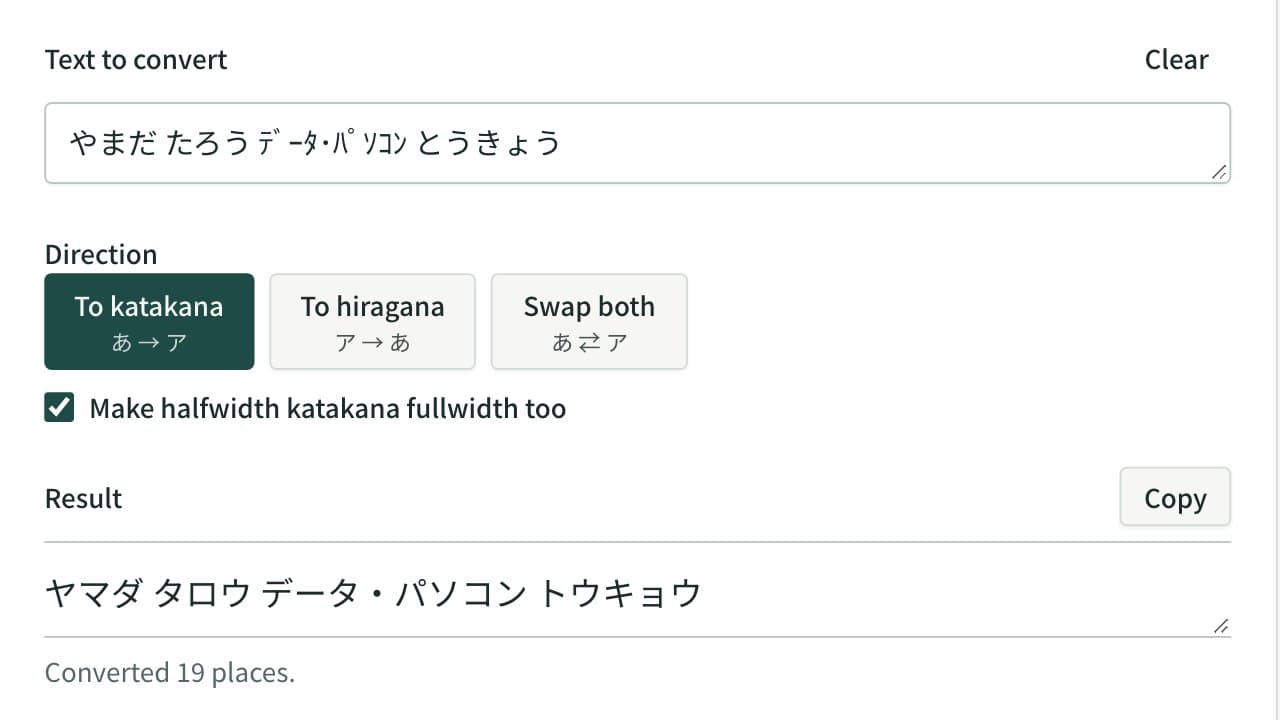
Convert hiragana to katakana, katakana to hiragana, or swap both in one pass. Halfwidth katakana can become fullwidth katakana or hiragana, and kana with a separate voiced mark are joined.
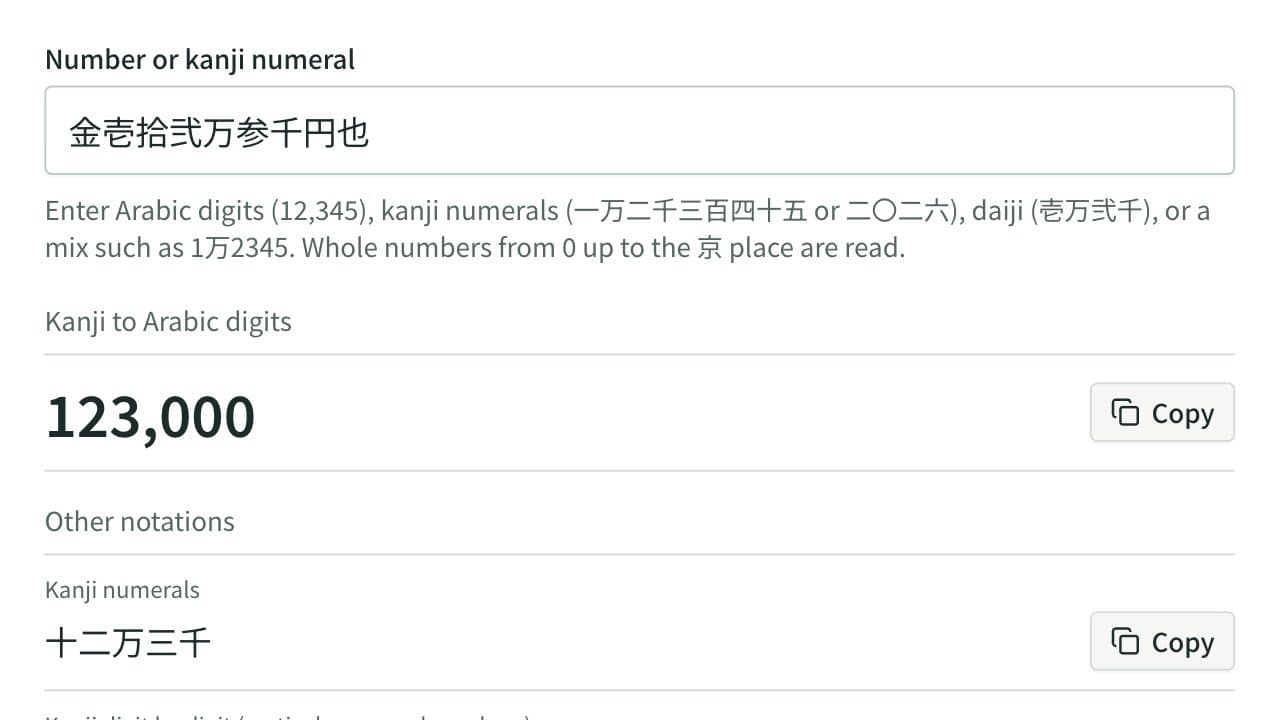
Kanji Numeral Converter
Convert numbers into kanji numerals (一万二千三百四十五), digit-by-digit kanji (二〇二六), and daiji (壱万弐千参百四拾五), and read kanji numerals and daiji back into numbers, with the receipt amount form and the 1万2345 style shown together, and a list with one number per line converted at once.
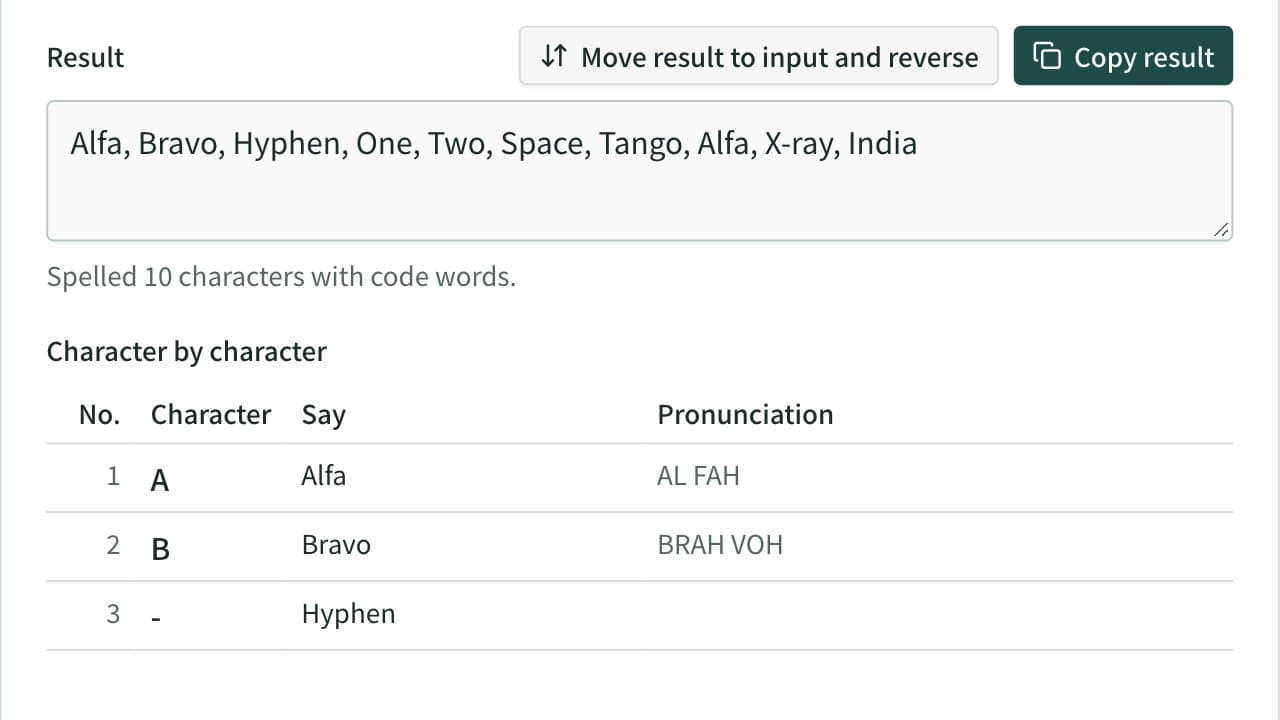
Phonetic Alphabet Converter
Spell letters, digits, and Japanese kana one by one with phonetic alphabet code words such as Alfa, Bravo, and 朝日のア, so they are not misheard over the phone or radio. You can also turn code words back into text.