Unit Price Comparison Calculator
Work out the price per 100 g, 100 mL, or piece from each item's price and amount, and rank up to 10 items to find the best buy. Handles multipacks, prices before 8% or 10% tax, and percent-off discounts.
The amount is what one pack (bag, bottle, roll) holds, and the count is how many packs the price buys. For a six-pack of 500 mL bottles, enter 500 mL and a count of 6.
Compare per
Enter the prices and amounts to see the unit prices and which is the best buy here
How to use
- For each item, enter its "Price (yen)" and "Amount", and choose the "Unit". Values such as
1,980or full-width1980are read too. - When the price buys several packs, such as a six-pack or a set of three bags, enter that number as the "Count". The amount is what one pack holds: a six-pack of 500 mL bottles is an amount of
500, unit mL, and a count of6. - If a flyer or online shop gives the price before tax, choose "Before 8% tax" or "Before 10% tax" under "Tax on the price". For a "20% off" or "half price" sticker, enter
20or50as the "Discount (%, optional)". - The result table ranks the items from the lowest unit price and names the best buy. Every other item shows how much (and what percent) dearer it is than the cheapest, and how much less the same amount would cost at the cheapest rate.
The bar under each unit price is drawn to a scale that ends at the dearest one. It is filled up to the cheapest unit price and hatched beyond it, so you can see at a glance how much extra each item costs. The bars use the unit prices before rounding. There are no bars for a single item or when every unit price is the same.
"Compare per" chooses what amount the unit price is for: per 100 g, per gram, or per kilogram. Volumes offer 100 mL, 1 mL, and 1 L, lengths (toilet paper, plastic wrap) offer 1 m and 100 m, and pieces (eggs, tissues) offer 1 piece and 100 pieces. "Add an item" takes you up to 10 items, and "Copy result" copies the ranks and unit prices as text.
How it works
- Price paid = price × (1 − discount %) × (1.08 or 1.10 for a price before tax)
- Total amount = amount × count (kg and L are multiplied by 1000 to g and mL)
- Unit price = price paid ÷ total amount × the amount compared per
The ranks use the unit prices before rounding. Prices are shown rounded half up to 0.01 yen and percentages to 0.1%. When two unit prices look the same but differ slightly, they still get different ranks. A gap so small that it rounds to 0 shows as "under 0.01 yen" or "under 0.1%" (as does a price paid or a unit price above 0 that rounds to 0 yen). Items with exactly the same unit price share a rank.
"X% more than the cheapest" takes the cheapest unit price as 100%. "The same amount costs X yen less at the cheapest rate" is the difference if you could buy that item's amount at the cheapest item's unit price. The cheapest item may not be sold in exactly that amount, so treat it as a guide.
Weight (g, kg), volume (mL, L), length (m), and pieces cannot be compared with each other. When the kinds of unit are mixed, the app says which item differs.
Example
Three ways the same rice is sold, compared per 100 g:
- Item A: 298 yen for 500 g (tax included)
- Item B: 540 yen for 1 kg (tax included)
- Item C: 330 yen for a set of three 200 g bags (before 8% tax), 20% off
"Copy result" copies this text:
Price per 100 g
#1 Item C: 47.52 yen (285.12 yen, 200 g × 3 = 600 g)
#2 Item B: 54.00 yen (540 yen, 1 kg; 6.48 yen or 13.6% more than the cheapest)
#3 Item A: 59.60 yen (298 yen, 500 g; 12.08 yen or 25.4% more than the cheapest)
Item C costs 330 yen × 0.8 × 1.08 = 285.12 yen for 600 g, which is 47.52 yen per 100 g. Item B's 1 kg would cost 475.20 yen at Item C's rate, which is 64.80 yen less.
Notes
- A price before tax times the tax rate is used as is, without dropping the fraction of a yen. Shops often round that fraction down at the register, so what you pay can differ by less than 1 yen.
- The discount applies to the price entered (the pre-tax price when it is before tax), and tax is added to the discounted amount. For a fixed amount off, enter the price after the reduction.
- Points, coupons, and shipping are not included. To compare online shops that charge shipping, enter the price with shipping added.
- Everything is calculated in your browser and nothing is sent or saved.
FAQ
Why does it differ slightly from the "per 100 g" on the shelf tag?
Shops may round the unit price on the tag to 1 yen or 0.1 yen. This tool works to 0.01 yen, so the last digits can differ. The tag may also be worked out from the price before tax.
How do I enter a bag that holds several smaller bags?
If the total amount is printed, enter it as the amount with a count of 1. If it says something like "10 g × 8 bags", an amount of 10 and a count of 8 gives the same result.
How do I compare toilet paper?
Set the unit to m, enter the length of one roll as the amount and the number of rolls as the count. For "12 rolls of 27.5 m", that is an amount of 27.5 and a count of 12. Compare per 1 m to see the price by length. Single-ply and double-ply are not alike by length alone, since double-ply has two layers.
Can I compare something sold by weight with something sold by volume?
No. When the kinds of unit differ, such as milk (mL) and yogurt (g), compare items labelled in the same kind of unit. If 1 mL of a liquid can be treated as 1 g, enter both in the same unit; the tool does not make that conversion itself.
Is the bigger size always the better deal?
No. A large pack often has a higher unit price than a smaller size on sale. A low unit price also costs more in the end if some of it goes to waste, so consider whether the size suits how much you use.
- Type
- Utility
- Category
- Calculators
- Tags
- shopping
- unit-price
- price
- money
- compare
- calculator
Related apps
Compound Interest and Savings Calculator
Work out what monthly deposits and a starting amount grow to with compound interest, split into contributions and gain, or find the monthly deposit needed to reach a target, with a year-by-year table. You can also see how long a balance lasts when you take out the same amount every month.
Electricity Cost Calculator
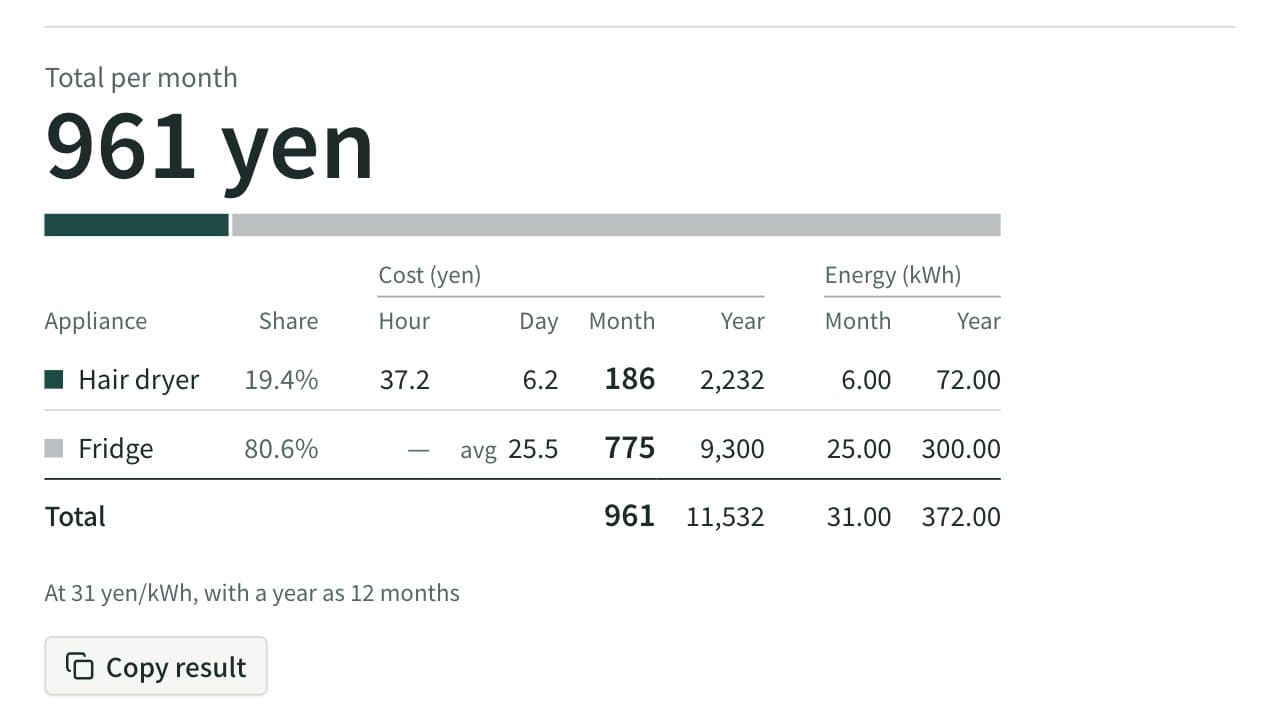
Work out the electricity cost of appliances per hour, day, month, and year from their power in watts and how long they run, or from the yearly kWh on a fridge or air conditioner label. Add several appliances to see the total and each one's share, or compare an appliance with its replacement to see the yearly saving and how long it takes to pay back.
Hourly Pay Calculator
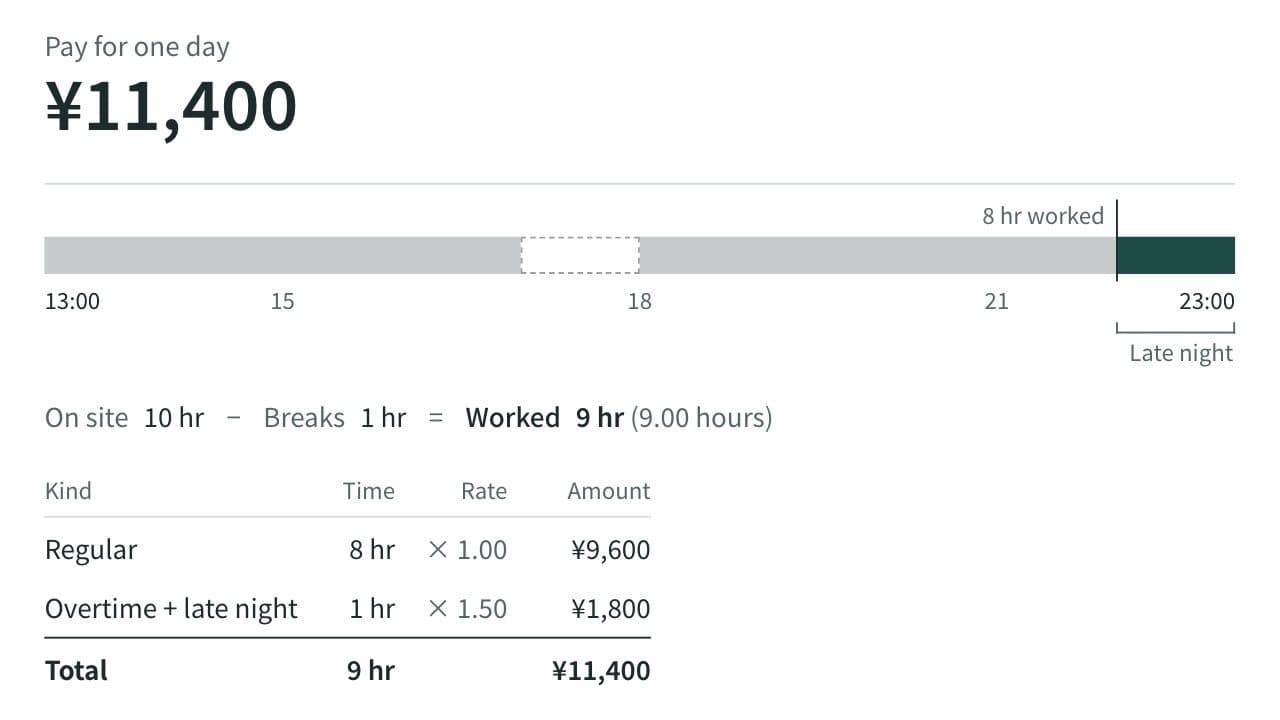
Calculate worked hours and a day's pay from an hourly wage, clock-in, clock-out, and breaks, with overtime past 8 hours, late-night work (22:00–05:00), and work on the statutory day off shown separately at premium rates.